GEO services in Montreal: be the name AI recommends
Boost One SEO is a Montreal GEO agency. We get companies named and cited when customers ask ChatGPT, Gemini, Claude, Perplexity and Google's AI who to call, in English and French.
Prefer to talk? Call 1-800-656-0685

Boost One SEO is a generative engine optimization (GEO) agency in Montreal, Quebec. GEO is the work of getting a business cited and recommended inside AI generated answers, from ChatGPT, Gemini, Perplexity, Claude and Microsoft Copilot to Google's AI Overviews and AI Mode. We have been a Montreal search agency since 2012, and we run GEO, answer engine optimization (AEO) and classic SEO as one program.
What is generative engine optimization?
Generative engine optimization, or GEO, is how you make your company the one an AI assistant names when someone asks for a recommendation. A customer types "who is a good immigration lawyer in Montreal" or "best kitchen renovation company on the South Shore" into ChatGPT or Claude, and the assistant answers with two or three names. GEO is the work that gets your name on that list, with accurate facts and a link back to you.
AI assistants do not invent those answers. They pull from the same web Google indexes: your site, your Google Business Profile, directories, reviews, press coverage, industry sites and forums. They look for businesses whose facts are consistent everywhere, whose pages answer the question directly and who are mentioned by sources the model already trusts. If those three things line up, you get cited. If they do not, a competitor does.
That is why GEO sits on top of SEO rather than replacing it. The technical health, content and authority that earn rankings on Google are the raw material AI engines work from. GEO adds the layer those engines need: clear entities, quotable answers, structured data and citations in the places they read. Our guides on what GEO is and SEO vs GEO go deeper if you want the long version.
Entity clarity
Does every source agree on who you are, what you do, where you are and who you serve? AI engines trust facts they can confirm in more than one place.
Quotable answers
Do your pages answer the questions buyers actually ask, in plain language, near the top, so a model can lift the answer and credit you for it?
Structure
Can a machine read your site without guessing? Schema markup, clean headings, crawlable pages and fast templates all matter here.
Citations
Are you mentioned on the sites, lists and directories AI engines already lean on for your category and your city? This is what separates "named" from "never mentioned".
GEO, AEO, AIO: what the letters mean
You will see all three terms used for AI search work, sometimes interchangeably. Here is how we use them, and how they fit together in one program.
GEO
Getting your business cited, named or recommended inside answers written by generative AI tools like ChatGPT, Gemini, Perplexity and Claude. Also called generative search optimization or LLM optimization.
- Goal: be one of the names in the answer
- Levers: entities, citations, answer ready content, schema
- Where it shows: chat assistants and AI search tools
AEO
Becoming the direct answer in features that reply with one result instead of ten links: Google AI Overviews, AI Mode, featured snippets and voice assistants.
- Goal: be the answer, not just a result on the page
- Levers: direct answer blocks, FAQ content, FAQ schema, accuracy
- Where it shows: the top of Google and voice results
AIO
The umbrella: SEO, GEO and AEO run together so you are visible and described accurately everywhere buyers search, with one plan and one report.
- Goal: cover Google and AI with one program
- Levers: everything above, coordinated
- Where it shows: Google results, Maps, AI answers
What our GEO services in Montreal cover
Six pieces of work, run together. Each one on its own helps a little. Together they are what turns "the AI has never heard of us" into "the AI recommended us".
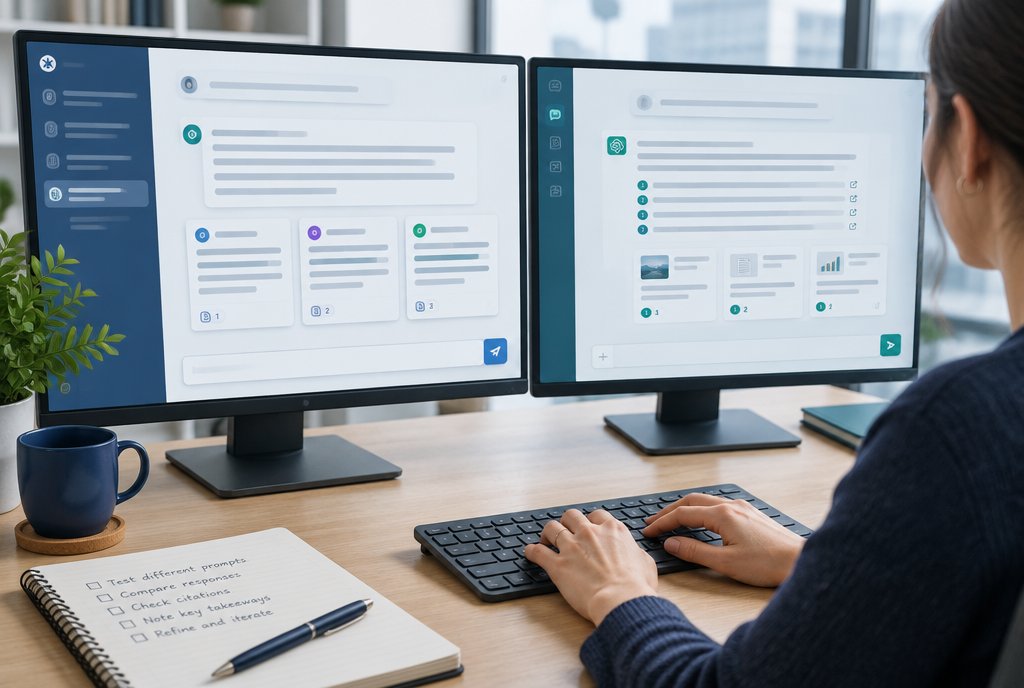
Prompt testing: find out what AI says about you today
Everything starts with a baseline. We write the prompts your customers actually use, in English and in French, and run them across ChatGPT, Gemini, Perplexity, Claude, Copilot and Google's AI Overviews and AI Mode. For each one we record whether you are mentioned, who is mentioned instead, which sources the answer cites and whether the facts about you are right. That becomes the scoreboard for the whole campaign.
- Buyer prompt map: the questions people ask before hiring a company like yours
- Baseline across every major assistant, in both languages
- Competitor view: who gets recommended in your category and why
- Source audit: which sites and lists the answers are drawing from
- Accuracy check on how each model describes your business
The free AI visibility check is a lighter version of this step. It is the quickest way to see where you stand before deciding anything.
Entity cleanup: make sure AI knows exactly who you are
AI engines build a picture of your business from dozens of sources, and most companies have contradictions they have never noticed: an old address on one directory, a different company name on another, services listed on your site that your Google Business Profile does not mention, a French listing that does not match the English one. Each inconsistency lowers the model's confidence, and low confidence means you get left out of the answer. We find every mention, fix what is wrong and fill in what is missing.
- Audit of your name, address, phone, services and descriptions across the web
- Google Business Profile and Bing Places aligned with your site, in both languages
- Directory and review profile corrections, including Quebec specific listings
- A clear "about" layer on your site: who you are, where you serve, what you specialize in
- Organization and LocalBusiness schema that states the facts in machine readable form
This step alone often moves the needle, because it is the cheapest thing for a model to verify and the thing most businesses get wrong.

Answer ready content: pages a model can quote
Assistants prefer pages that answer a question directly, then back it up. Most service pages do the opposite: three paragraphs of introduction before anything useful. We rebuild your priority pages around the questions buyers ask, put the short answer near the top, follow it with the detail and proof, and add the comparison and FAQ content that AI tools reach for when they need to recommend one option over another.
- Direct answer blocks at the top of service and location pages
- FAQ sections written from real customer questions, not keyword lists
- Comparison and "how to choose" pages for the decisions your buyers make
- Bilingual content that reads naturally in each language instead of being translated
- Refreshes of existing pages so facts, dates and services are current
Our guide on structuring content so AI references your website shows the method, page by page.

Schema and structure: a site a machine can read without guessing
Structured data is the closest thing to speaking an AI engine's language. Organization, LocalBusiness, Service, FAQ, Product and Review schema tell crawlers what each page is, who it belongs to and which facts are which. We also make sure the basics hold: your pages are crawlable by the bots that feed AI tools, your templates load fast, your headings mean something and your French and English versions are correctly linked.
- Full schema graph for your organization, services, locations, FAQs and reviews
- Crawl access for AI and search bots, with nothing important blocked by accident
- Clean heading structure and internal links so context carries from page to page
- Hreflang and bilingual markup done properly
- Speed and rendering fixes so content is actually seen, not skipped
If your site is on WordPress, Shopify, Webflow or something custom, we implement directly or hand your developer tested instructions.
Citations: get mentioned where AI engines already look
When a model recommends "the best SEO agency in Montreal" or "a reliable roofer in Laval", it is leaning on sources it has learned to trust: industry directories, local media, "best of" lists, review platforms, association sites and well read forums. Being absent from those sources means being absent from the answer. We find the ones that matter for your category and your city, earn placements the honest way and keep your facts consistent on every one of them.
- Citation gap analysis against the competitors AI tools currently name
- Placement on the directories, lists and publications that feed AI answers
- Digital PR and press releases for announcements worth covering
- Review strategy so your rating and review count support the recommendation
- Brand mention monitoring across the web
We wrote about why "best in town" lists earn AI citations, which explains a big part of this step.

AI visibility reporting: see the change month by month
GEO is measurable, as long as you measure the right things. Every month we re-run the prompt set, track how often you are mentioned and cited, watch how each assistant describes you, and connect that to the traffic and leads arriving from AI tools in Google Analytics 4. You get a plain language summary, the data behind it and a call with the strategist who runs your account.
- Mention and citation rate across the full prompt set, by assistant and by language
- Share of voice versus the competitors named alongside you
- Accuracy and sentiment of how AI tools describe your business
- Traffic and conversions from AI referrers, plus impressions in Google's AI features
- Monthly review call and next month's priorities
Not sure which platform matters most for your business? Read which AI search platform actually sends customers.

The AI engines we optimize for, and how each one picks its answers
Each assistant builds its recommendations a little differently. Knowing where the answers come from is half of knowing how to get into them.
ChatGPT
Combines what it learned in training with live web search when a question needs current or local information. Recommendations lean on well cited pages, review platforms and lists it can verify, and answers often include links to sources.
AI Overviews and AI Mode
Generated from Google's own index and shown above the regular results. If your pages rank well and answer clearly, you are a candidate to be cited. Search Console now reports impressions from these features, which makes progress easy to track.
Gemini
Grounded in Google Search and Google Maps, which makes your Google Business Profile, reviews and local pages unusually important. A consistent, complete profile is one of the fastest wins here.
Perplexity
Runs a live search for nearly every question and cites its sources inline. It favours recent, specific pages and community discussion, so fresh content and real mentions carry a lot of weight.
Copilot
Built on Bing's index, which many businesses have never optimized for. Bing Places, Bing Webmaster Tools and the same clear facts and schema as everywhere else get you into Copilot's answers.
Claude
Uses web search to answer current questions and tends to prefer sources that state facts plainly and back them up. Clear "about" information and consistent citations are what get a business named here.
The assistant looks for agencies whose sites describe GEO services clearly, whose facts match across Google, directories and reviews, and who are mentioned on lists and articles about AI search in Montreal. Our job is to make sure that description fits you.
Named, described accurately and linked. That is the outcome of every piece of work on this page. Start with the simple test: does ChatGPT recommend your business today?
What AI visibility looks like when the work is done
Numbers from client campaigns, taken from Google Search Console and the clients' own lead tracking. Each card links to the full write up.
Impressions in Google's AI features
A kitchen and bathroom renovator went from 406 to 9,720 impressions inside Google's AI features in three months, while leads from the site grew four times over six months.
Read the renovation case study → +48%Impressions, and a place in AI Overviews
A tile manufacturer moved from the bottom of page three to the top of page two, grew impressions 48% and clicks 23% in six months, and now appears in AI search and AI Overviews.
Read the manufacturer case study → MTLHow Montreal businesses show up in AI today
Our Montreal AI driven search exposure report looks at which local businesses AI assistants recommend right now, and what the ones that get named have in common.
Read the Montreal report →An AI SEO company in Montreal, for a city that searches in two languages
Montreal buyers ask AI assistants the same questions they used to ask Google, in French and in English, about businesses three boroughs away and companies on the other side of the world. Here is how we handle each situation.

AI SEO company in Montreal
"AI SEO" is the label most people reach for when they notice customers are asking ChatGPT or Claude instead of Google. It means the same thing as GEO in practice: making a business visible and accurately described wherever AI tools look for answers. As an AI SEO agency in Montreal, we treat it as an extension of the search work we have done since 2012, not a separate discipline with its own tricks.
The practical question is simple. When a customer asks an assistant who to call for what you do, does your company get named? We test it, we measure it and we build toward it, with the same foundation of technical health, clear content and real authority that our SEO services are built on. Read more about our approach to AI search optimization.
- Prompt testing across ChatGPT, Gemini, Perplexity, Claude and Copilot
- Entity cleanup so AI knows exactly who you are
- Answer ready pages built to be quoted

AEO agency Montreal: answer engine optimization
Answer engines are the features that reply with one answer instead of a list of links: Google's AI Overviews and AI Mode, featured snippets, voice assistants on phones and speakers. For a lot of searches in Montreal, that single answer is now the whole result page. If it names you, you get the call. If it names someone else, most people never scroll further.
Our AEO services shape your pages so the direct answer sits near the top, in plain language, backed by facts an engine can confirm. We add FAQ content and schema for the questions that trigger these features and we check, month by month, how the engines describe you. If you have ever ranked first and wondered why the phone stopped ringing, our post on ranking #1 but getting no clicks explains what changed.
- Direct answer blocks on priority pages
- FAQ content and FAQ schema built from real questions
- Accuracy checks on how AI Overviews and assistants describe you
GEO for local businesses in Montreal and the suburbs
"Best dentist in Westmount." "Good plumber near Rosemont." "Who does kitchen renovations in Laval?" Local recommendations are the questions AI assistants get asked most, and the answers come from a short list of sources: your Google Business Profile, your reviews, local directories, neighbourhood lists and your own location pages. Clinics, contractors, law firms, restaurants and showrooms live or die on those few sources.
We make sure each one says the same thing about you, that your reviews support the recommendation and that you have a page for every area you serve. Combined with our local SEO Montreal work, it covers the map pack and the AI answer at the same time, because for a local search they draw from the same well.
- Google Business Profile and Bing Places complete in both languages
- Location pages for the boroughs and suburbs you serve
- Reviews, citations and local lists that AI tools read
Bilingual GEO: the French answer and the English answer are not the same
Ask an assistant the same question in French and in English and you will often get two different shortlists. The models draw on different sources in each language, and a business with a thin French presence can be recommended in English and invisible in French, or the reverse. In Quebec, that is half your market.
We test prompts in both languages, fix the facts in both languages and write content for each audience rather than translating one into the other. Listings, schema and your Google Business Profile are kept consistent across the two versions, which is where most bilingual sites quietly lose ground.
- Separate prompt sets and baselines for French and English
- French pages written for Quebec, not imported from France
- Hreflang, bilingual schema and listings handled properly

GEO for B2B and national companies
Manufacturers, distributors, software companies and professional firms have a different problem. Their buyers ask AI assistants to compare suppliers, explain specifications and shortlist vendors across a whole country, long before a sales call. The sources that matter are industry directories, comparison pages, technical documentation, trade publications and the company's own explanations of what it does and for whom.
As a B2B SEO agency we build that footprint: pages that answer the questions in a buyer's research phase, citations in the places the models look for a category, and facts consistent enough that an assistant can describe you confidently to someone in Toronto, Chicago or Paris. We have written specific guides for GEO for manufacturers and GEO for clinics.
- Prompt mapping by buying stage and decision maker
- Comparison, specification and "how to choose" content
- Citations in industry sources, across markets and languages

GEO and SEO, run as one program
Every GEO program we run sits on top of solid Google SEO, because that is where the models get their material. A page that cannot be crawled, a site with no authority or content that does not answer anything will not be cited no matter how much "AI optimization" is layered on top. The reverse is also true: good SEO work now lifts both the ranking and the recommendation.
So we do not sell GEO as a separate product you bolt onto a site. It is a layer of the same program, with one strategist, one plan and one monthly report that covers Google results, the map pack and AI answers together. If you are already working with an SEO agency and want to add AI visibility, we can scope that too.
- One roadmap covering Google, Maps and AI assistants
- Technical, content and authority work that serves both
- One report, one review call, no overlapping vendors
How a GEO campaign with Boost One works
Five phases, in order. You see the baseline and the plan before any work begins, and you decide whether to continue.
Free AI visibility check
We run the questions your customers ask through the major assistants and show you the results on a short call: whether you are named, who is named instead, which sources the answers rely on and what the three most useful fixes would be. You keep the findings whether or not we work together.
Baseline and prompt map
If it makes sense to go further, we build the full prompt set in both languages, record a complete baseline across every assistant, audit every place your business is mentioned on the web and map the gaps between you and the companies currently being recommended. This becomes the plan you approve.
Fix the facts
Entity cleanup, schema and structure come first, because they are the fastest things for a model to verify. Your name, services, locations and descriptions are made consistent everywhere, your site states who you are in machine readable form and nothing important is hidden from the bots that feed AI tools.
Content and citations
Then the work that compounds: answer ready pages for the questions in your prompt map, FAQ and comparison content, and placements on the directories, lists and publications the assistants draw from. Each month adds sources a model can check, and confidence builds.
Re-test, report, adjust
The prompt set is re-run, mentions and citations are tracked, accuracy is checked and the results go into a plain language report. We review it with you on a call, look at what the models changed and agree on the next month's priorities. No surprises and no jargon.
Start With the Free CheckHow we know GEO is working
AI search does not come with a rankings report, so we built our own way of keeping score. These are the numbers in your monthly report.
Mention rate
Out of the full prompt set, how often each assistant names your business. Tracked by platform, by language and over time, so you can see ChatGPT improve before Gemini or Claude does, or French catch up to English.
Citation rate and sources
How often your site is cited as a source, and which other sites the answers lean on. When a directory or article keeps showing up in the sources, that is where the next placement goes.
Share of voice
Who is named alongside you, and how often. The goal is not only to appear but to appear more often than the competitors a customer would otherwise call.
Accuracy and sentiment
Whether the assistants describe you correctly: right services, right areas, right strengths. A wrong fact in an AI answer loses a lead as surely as being left out.
AI referrals and conversions
Visits, calls and form submissions that arrive from ChatGPT, Claude, Perplexity, Copilot and other AI referrers, set up in Google Analytics 4 so the business impact is visible, not assumed.
Google AI feature impressions
Search Console now reports how often your pages appear in AI Overviews and AI Mode. It is the clearest signal for the Google side of the work and one of the first numbers to move.
GEO services across Montreal, Quebec and beyond
We're in Old Montreal, and many of the businesses we work with are on the island or a short drive away. For local companies, AI recommendations are neighbourhood by neighbourhood, so that is how we plan the work.
- Downtown and Ville-Marie
- Old Montreal and Griffintown
- Le Plateau-Mont-Royal and Mile End
- Rosemont and Villeray
- Outremont and Westmount
- NDG and Côte-des-Neiges
- Verdun and LaSalle
- Saint-Laurent and Ahuntsic
- Anjou and Saint-Léonard
- Pointe-Claire, Dorval and the West Island
- Laval
- Longueuil and the South Shore
AI assistants do not care where a company is based, and neither do we. We run GEO programs for businesses across Quebec, the rest of Canada, the United States and Europe, and you can read about the cities we work in most on our SEO services by city page.
- Quebec City
- Gatineau
- Sherbrooke
- Trois-Rivières
- Ottawa
- Toronto
- Vancouver
- New York City
- Boston
- Paris
- London
- Across Canada, the US and Europe
Why Montreal businesses choose us for GEO
A lot of agencies added "AI" to their service list last year. Here's what's different about working with us.

- Search specialists in Montreal since 2012, with more than 1,000 websites along the way
- Certified Google Partner and Semrush Agency Partner
- The strategist you meet on the first call is the one who does the work
- French and English prompts, content and listings handled by our own team
- Real citations and real content, nothing that gets a site penalized
- Monthly reports that show mentions, citations and leads, not vanity numbers
You'll see the baseline before you decide anything
The free AI visibility check is a real test, not a pitch. You'll see what each assistant says about you today, who it recommends instead and what we'd fix first. If the gap is small, we'll tell you. If we're not the right fit, we'll say so. Most people who go ahead with us say that first call is what convinced them.
If you want to understand the field before talking to anyone, our guides on what GEO is, SEO vs GEO and whether ChatGPT recommends your business are a good place to start.
Get the Free CheckWe've been doing the foundations for twenty years
GEO is new. The things that make it work are not: accurate business information, pages that answer questions, a site a machine can read and mentions on sources people trust. We have been building those for Montreal companies since 2012, which is why our AI visibility work starts from a foundation instead of a theory.
That also means we know what breaks. A redesign that hides half the site from crawlers, a listing with the wrong phone number, a page that buries the answer in paragraph four. We check for all of it, log every change and show you what moved the numbers.
Ask Us a QuestionWhat clients say about working with us
“It's been my pleasure to work with Boost One to enhance our SEO over the past 6 months. The sales activity shows that it's working!”
— Christina D.“Top in their field… results yielded positive returns and helped us become the #1 reference for large group food events.”
— Daniel P.“Very happy with their work, my phone is ringing non-stop. Best part: they’re reachable anytime.”
— Pankaj R.“Boost was a huge help to me and my business… content, site audits and other great pointers… highly recommend.”
— Benjamin W.“Excellent service by Brandon. Communication is great and I’m always kept up to date. Tremendous help for my website.”
— Martin M.“Been working with Boost for a few years… nothing but positive experiences with campaigns and business growth.”
— Devon S.GEO services in Montreal: your questions answered
The questions business owners ask us before starting AI search work, answered the way we answer them on a call.
GEO explained
what it is, how it relates to SEO and what it is notWhat is generative engine optimization?
Generative engine optimization (GEO) is the work of getting a business cited and recommended inside answers generated by AI tools such as ChatGPT, Gemini, Perplexity, Claude, Copilot and Google's AI Overviews. It involves making your business facts consistent across the web, publishing content that answers buyer questions directly, adding structured data and earning mentions on the sources those tools draw from.
How does GEO work?
AI assistants answer from the web they can read: your site, your listings, reviews, directories, articles and forums. GEO works by making your company easy for them to find, understand and verify. We test what the assistants say today, fix the facts, restructure key pages so the answer is quotable, add schema and build citations in the places the models trust. Then we re-test every month and adjust.
What is the difference between SEO and GEO?
SEO gets your pages to rank in search results. GEO gets your business mentioned or cited inside AI generated answers. They share the same foundation of technical health, content and authority, which is why we run them together. SEO wins the click, GEO wins the recommendation. Our SEO vs GEO guide covers the details.
Is GEO the same as AEO or AI SEO?
They overlap. AI SEO is the broad label for optimizing your presence for AI driven search. AEO, answer engine optimization, focuses on being the direct answer in features like Google AI Overviews and voice results. GEO focuses on being cited in answers from generative tools like ChatGPT, Claude and Gemini. AIO, AI optimization, is the umbrella for all of it. At Boost One SEO they are one program.
Results and timelines
how long it takes, what to expect and how it is measuredHow long does GEO take to show results?
Entity fixes and schema are often picked up within a few weeks, and we usually see the first new mentions within 60 to 90 days. Broader, consistent recommendations across several assistants build over three to six months as content and citations accumulate. Competitive categories in Montreal take longer than niche ones, and we tell you what to expect for yours on the first call.
Can you guarantee that ChatGPT or Claude will recommend my business?
No, and anyone who promises that is guessing. AI tools decide their own answers, and they change often. What we commit to is the work and the measurement: a baseline, a clear plan, monthly re-tests and transparent reporting. In our case studies that work has produced a 24x increase in Google AI feature impressions and new recommendations across assistants, but the results depend on your market and your starting point.
How do you measure GEO?
We re-run your prompt set every month and track mention rate, citation rate, share of voice against competitors, and the accuracy of how each assistant describes you. We also track visits and leads arriving from AI referrers in Google Analytics 4 and impressions in Google's AI features in Search Console. All of it goes into one plain language report.
Will GEO help my Google rankings too?
Usually, yes. Consistent business information, pages that answer questions directly, structured data and mentions on trusted sites are all things Google rewards as well. Most clients see their regular rankings and map pack visibility improve alongside their AI visibility, which is one reason we treat the two as one program.
Montreal, Quebec and bilingual questions
local recommendations, French and EnglishDo AI assistants recommend local businesses in Montreal?
Yes, and more every month. Questions like "best physiotherapist in the Plateau" or "a good roofer in Laval" get a short list of named businesses, usually drawn from Google Business Profiles, reviews, local directories and neighbourhood lists, whether the question is asked in ChatGPT, Claude, Gemini or Perplexity. If your information on those sources is complete and consistent, you are a candidate. If it is not, the assistant names someone else.
Do I need GEO in French and in English?
If you serve Quebec customers, yes. Assistants often give different recommendations in each language because they draw on different sources. A business with strong English content and thin French content can be recommended in one language and ignored in the other. We test, fix and write in both.
Which AI tool matters most for a Montreal business?
It depends on your customers. Google's AI Overviews reach the most people because they appear inside normal Google searches, ChatGPT is the most used standalone assistant, Claude is growing quickly with professional users, and Perplexity and Copilot matter more in research heavy B2B categories. We test all of them and tell you where your buyers actually are. Our post on which AI search platform sends customers has more.
Can you help a company with several locations across Quebec?
Yes. Each location gets its own listings, its own pages and its own place in the prompt set, under one strategy so the locations support each other. This is common for clinics, dealerships, franchises and service companies with offices in Montreal, Laval, Longueuil and Quebec City.
Working with us
what is included, contracts and how to startWhat is included in your GEO services?
Prompt testing and a baseline across the major assistants in both languages, entity cleanup of your business information everywhere it appears, answer ready content, schema and site structure, citation building on the sources AI tools draw from, and monthly AI visibility reporting with a review call. Classic SEO work is folded in where your site needs it.
Do you require long term contracts?
No. We do not lock clients into contracts. We do recommend planning on at least three to six months, because that is how long it takes for content and citations to accumulate and for the assistants to update what they know about you. You see the baseline and the plan before you start, and you continue because the results make sense.
Can you add GEO to SEO work we already do with another agency?
Yes. We scope the AI visibility layer on its own: prompt testing, entity cleanup, schema, answer ready content and citations, with reporting that sits alongside your existing SEO reports. We coordinate with your current agency or in house team so nobody duplicates work.
What happens on the free AI visibility check?
Before the call, we run the questions your customers ask through ChatGPT, Gemini, Claude, Perplexity and Google's AI features. On a short video call we show you whether you are named, who is named instead and the three fixes that would help most. There is no obligation, and you keep the findings. You can book it through the free AI visibility check page or call us at 1-800-656-0685.
Find out what AI says about you
Pick whichever fits where you are. No pressure either way.
Free AI visibility check
We test what ChatGPT, Gemini, Claude, Perplexity and Google's AI say about your business, then walk you through it on a short call. You keep the findings either way.
Get My Free Check →Send us a message
Have a question first, or a project that does not fit a neat box? Write to us and a strategist will reply, usually within one business day.
Contact Boost One SEOLearn how it works first
Not ready to talk? Our guides explain GEO in plain language, from what GEO is to how to structure content so AI references you.
Read About AI Search OptimizationOr just pick up the phone
Toll free, in English or French. If we miss you, leave a message and we'll call you back.