BoostOne, Author at Boost One SEO

How a Company Half Your Size Is Stealing Your #1 Spot on Google

You have been in your industry for 15 years. You have 400 employees, a sales team that closes seven-figure deals, and brand recognition that opens doors before anyone picks up the phone. You have spent millions on your website, your content team, and your digital presence.

So why, when you Google “enterprise fleet management software” or “best HR platform for mid-size companies,” is a startup founded four years ago sitting in the number one spot?

Not buried on page two. Not showing up in some fringe long-tail result. They are right there at the top, taking the click that should be yours. And it is not a fluke. You keep searching your core terms, and they keep appearing. Above you. Every single time.

This is not a branding problem. It is not a content quality problem. And it is definitely not because they are smarter than you.

It is an SEO execution problem. And once you understand what is actually happening, you will see why fixing it is well within your reach.

Why Is a Smaller Competitor Outranking Us on Google?

Why Is a Smaller Competitor Outranking Us on Google

The short answer is that Google does not care how big your company is. It does not care about your revenue, your headcount, or the fact that your CEO spoke at Davos. Google cares about one thing: which page best answers the question someone just typed into a search bar.

Smaller competitors tend to be better at answering that question, and it comes down to a handful of very specific structural advantages they have over you. None of these advantages are permanent. But all of them are real right now.

Does Brand Size Actually Matter for SEO Rankings?

Brand size matters, but not in the way most executives assume. A well-known brand creates higher click-through rates when people see it in search results. It generates more branded searches, which send positive signals to Google. And it earns trust from other websites that are more likely to link to an established company.

But none of that helps you if your website is technically broken, your content does not match what people are actually searching for, and your internal processes make it impossible to move quickly.

Think of it this way. Brand authority is fuel. SEO strategy is the engine. You have a full tank of gas sitting in a car with no transmission. The smaller company has a quarter tank in a car that actually runs. They are going to get further.

How Smaller Companies Build SEO Strategies That Beat Enterprise Brands

How Smaller Companies Build SEO Strategies That Beat Enterprise Brands

Here is what that four-year-old competitor is doing that you are not. None of this is secret. None of it is revolutionary. But they are executing on all of it simultaneously while you are stuck in committee meetings debating font choices on your homepage.

They built their website recently, and it shows. Their site runs on a modern tech stack without 12 years of accumulated bloat. No legacy third-party scripts loading on every page. No committee-designed templates that try to serve 14 different stakeholder requests at once. Their Core Web Vitals scores are better than yours by default. Not because their developers are geniuses, but because they do not have the baggage you do. Google uses page speed and user experience as ranking factors. Your competitor passes those tests without even trying.

They write content the way their buyers actually search. Pull up your website right now and look at your product pages. There is a good chance they say things like “integrated workforce optimization solutions” or “end-to-end customer engagement platform.” That is how your product team talks about your product internally. It is not how anyone searches for it on Google.

Your smaller competitor’s blog says “how to reduce employee turnover in warehouses.” It says “best way to track driver hours without spreadsheets.” They are matching real search intent, word for word, and Google rewards that with rankings. Your internal jargon is invisible to search engines because nobody types it into Google.

Every page on their site has a job. Their blog posts link to pillar pages. Their pillar pages link to product pages. Their product pages have schema markup and a clear path to conversion. The entire site works like a funnel, guiding both users and search engines through a logical structure.

Your site? It is a maze. Orphaned campaign landing pages from 2019 that nobody owns. Microsites that were supposed to be temporary but never got taken down. PDFs that are indexed but lead nowhere. Blog posts that overlap and compete with each other for the same keywords. If you want to understand how to create service pages that rank and convert, you have to start by accepting that most of yours currently do neither.

They earn backlinks because they give things away. Your competitor publishes original research, free tools, templates, and calculators. A logistics company publishes a free fuel cost calculator. A recruiting firm publishes salary benchmark data. These resources get linked to by journalists, bloggers, and other websites because they are genuinely useful.

Your company, meanwhile, puts its best content behind a gated form. Nobody fills out a form to read a whitepaper anymore. That gated PDF never gets linked to, never gets shared on social media, and never builds the domain authority you need to rank. You are sitting on incredible data and expertise and locking it in a vault where Google cannot see it.

They make decisions in days. You take months. Your smaller competitor can go from identifying a keyword opportunity to publishing a fully optimized blog post in a week. Maybe less.

At your company, a single content brief needs approval from legal, brand, product marketing, and IT. Changing a meta title requires a ticket in the dev queue. Updating a landing page means coordinating across three departments and two agencies. By the time you approve a piece of content, your competitor has already published theirs, gotten it indexed, and started ranking for the term you were planning to target.

Speed is a competitive advantage in SEO, and right now, your org chart is your biggest bottleneck.

What Is Content Cannibalization and Is It Hurting Your Rankings?

Almost certainly, yes. Content cannibalization happens when multiple pages on your site compete for the same keyword. Instead of one strong page ranking well, you end up with three mediocre pages splitting authority and confusing Google about which one to show.

This is extremely common at large companies. Over the years, different teams publish content without coordinating. Your product marketing team creates a landing page for “supply chain visibility.” Your content team writes a blog post about supply chain visibility. Your solutions team builds a microsite that also covers supply chain visibility. Now Google has to choose between three of your pages, and it often chooses none of them.

Your competitor has one page targeting that term. It is thorough, well-structured, and links to all the right places on their site. Google knows exactly which page to rank. You have made Google’s job harder, and Google does not reward that.

Why Your Website Redesign Killed Your Search Rankings

If your company recently went through a website redesign and your rankings dropped, you are not imagining things. This happens constantly to large organizations, and it almost always comes down to the same mistakes.

URLs changed without proper 301 redirects. Pages that were ranking well got deleted or restructured without anyone checking their organic traffic first. The new design prioritized visual aesthetics over page speed, loading heavy images, animations, and JavaScript that tanked your Core Web Vitals. Internal linking structures that took years to build got wiped out overnight.

Most web design agencies are not SEO agencies. They build beautiful websites. They do not build websites that rank. And if nobody on your side was specifically managing SEO during the redesign, you likely lost months or years of accumulated search equity without realizing it until the traffic reports came in.

How to Fix Slow Page Speed on Enterprise Websites

Page speed is a ranking factor, and enterprise websites are almost always slower than they need to be. The culprit is rarely one big thing. It is dozens of small things that have accumulated over the years.

Third-party tracking scripts that fire on every page load. Uncompressed images that are 4MB when they should be 200KB. Legacy CSS and JavaScript files that are still loading even though the features they supported were removed two redesigns ago. Tag managers overloaded with pixels from campaigns that ended in 2021.

Fixing this requires a technical audit that goes deeper than what most web development agencies typically perform. It means cataloging every script, every image, every resource that loads on your key pages and asking whether it needs to be there. For companies serious about comprehensive SEO services, a technical cleanup is not optional. It is the foundation everything else gets built on.

Why Your Competitors Rank for Keywords You Should Own

You already have everything you need to dominate your search landscape. You have the budget. You have the brand recognition. You have customers who could provide case studies and testimonials. You have proprietary data that could fuel original research. You have subject matter experts who could be quoted in industry publications.

The problem is that none of these assets are being converted into SEO performance.

Your budget goes to paid ads instead of organic content. Your case studies sit in a sales deck instead of on a public webpage. Your data lives in internal reports that nobody outside your company ever sees. Your experts share their knowledge in gated webinars instead of in indexable blog posts.

Meanwhile, your smaller competitor takes every single asset they have and squeezes maximum SEO value from it. They do not have more. They just waste less.

SEO for Large Companies vs Small Companies

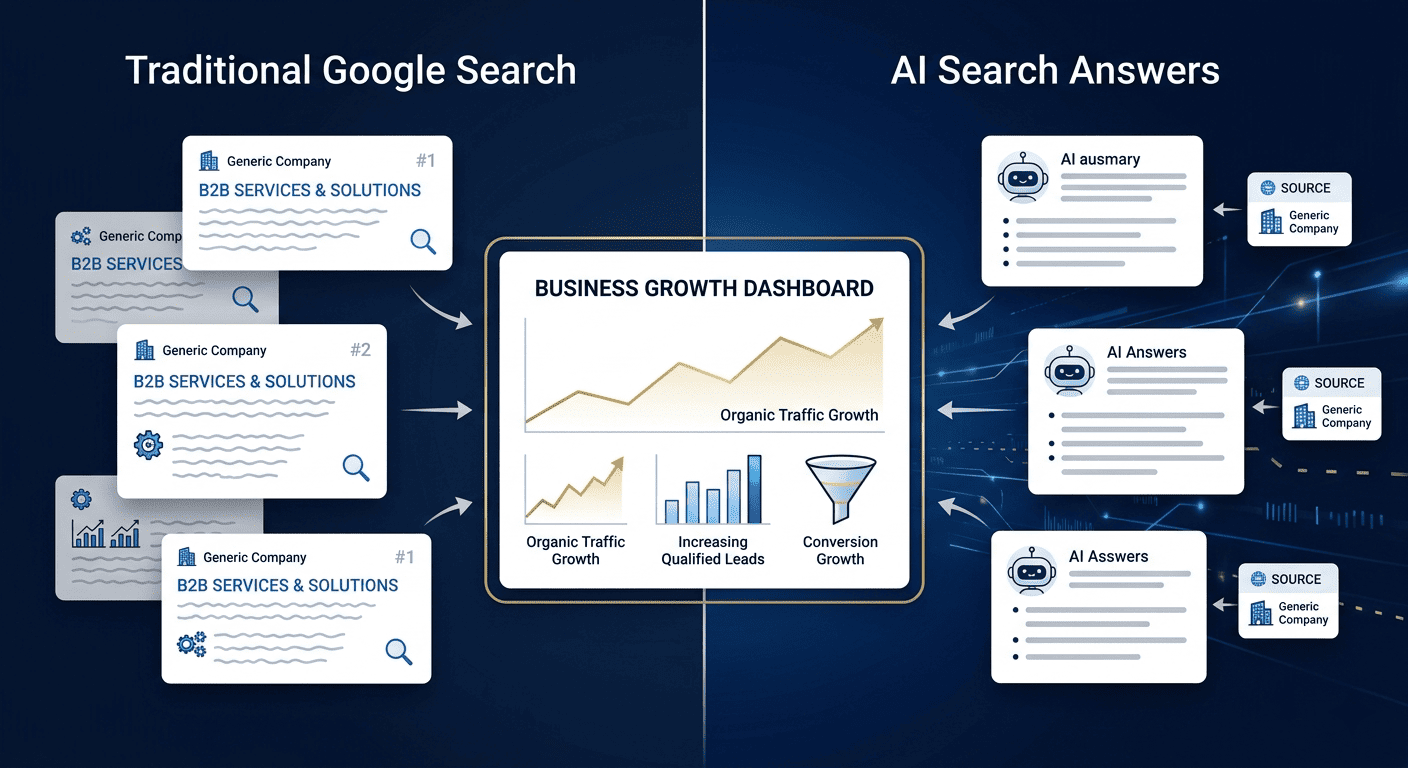
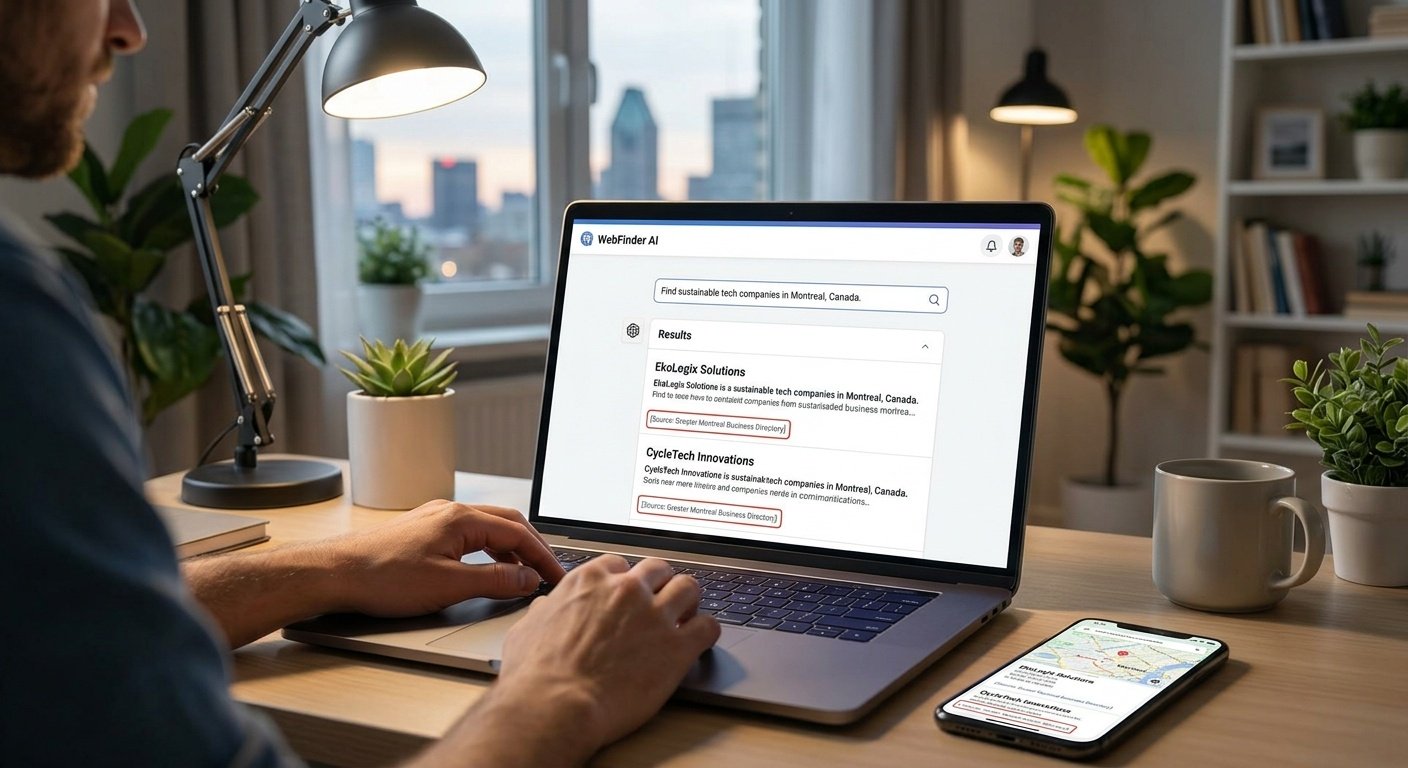
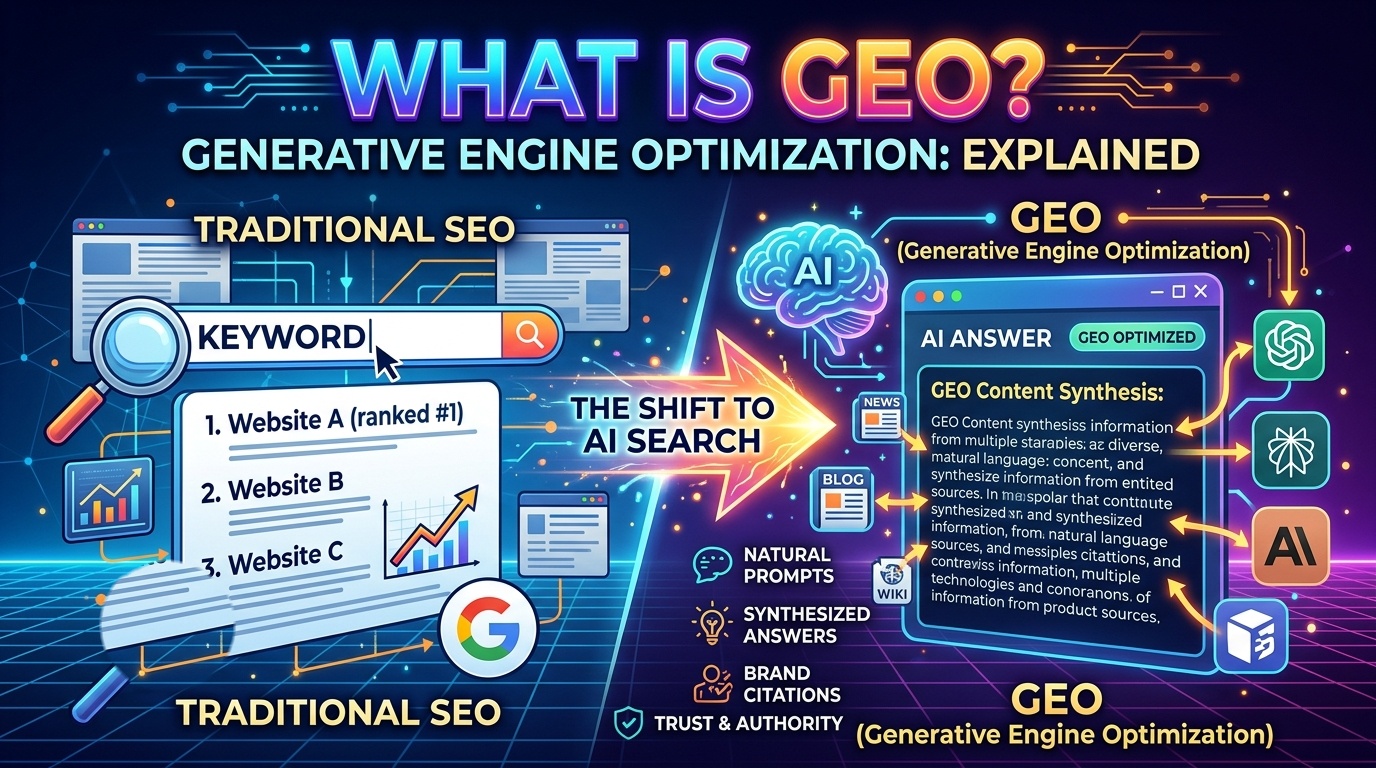
The dynamics of SEO are shifting, and this goes beyond traditional search. With AI-driven search experiences reshaping how people find answers, large companies need to think about visibility across both conventional search engines and generative engine optimization strategies. The companies that adapt to both will pull ahead. The ones that only optimize for Google as it existed five years ago will keep losing ground.

For international companies entering the North American market, the challenge is even steeper. You are not just competing against entrenched domestic players. You are trying to build domain authority from zero in a market where search behavior, content expectations, and competitive dynamics are completely different from what you are used to at home. Understanding the difference between SEO and GEO strategies is critical when you are building visibility across regions for the first time.

The good news is that large companies hold structural advantages that smaller competitors cannot replicate. You just need to start using them.

What You Should Do About It

If you have read this far and recognized your own company in every section, here is where to start.

Run a real content audit. Not a spreadsheet that lists your URLs. A page-by-page analysis that identifies which content is helping you rank, which is cannibalizing your own pages, and which is actively dragging your domain authority down. Most enterprise websites have hundreds of pages that should be consolidated, redirected, or removed entirely.

Build a keyword strategy around buyer behavior, not internal language. Stop targeting the terms your product team uses in meetings. Start targeting the phrases your potential customers actually type into Google. This requires keyword research that starts with search data, not with your brand guidelines.

Fix your technical debt. Hire someone who can audit your site architecture, your page speed, your crawl budget, and your indexation issues. Your web development agency built your site to look good. You need someone to make it perform.

Create an SEO governance model. The speed advantage smaller companies have disappears when you build internal processes that let your team move quickly. Designate clear ownership for SEO decisions. Reduce approval chains for content and technical changes. Give your marketing team the authority to publish without routing every piece through four departments.

Integrate SEO into your broader marketing services strategy. SEO does not work in a silo. It needs to connect to your content marketing, your social media, your PR, and your paid campaigns. When all channels feed into each other, the compound effect on organic visibility is significant.

The Real Opportunity

Here is the part that should actually make you optimistic. That smaller competitor beating you on Google right now? They have maxed out their advantages. They do not have your budget to invest in large-scale content production. They do not have your customer base to generate case studies. They do not have your brand authority that earns trust and clicks. They do not have your data to produce original research that earns backlinks.

They are winning because they are focused. Not because they are better resourced. And focus is something you can build.

The gap between where you are and where you should be is not a talent gap or a budget gap. It is an execution gap. And execution gaps close fast once you have the right strategy and the right team behind it. If you want to talk through what this looks like for your specific situation, book a free consultation and we will walk through exactly where you are losing ground and how to take it back.

Read More
BoostOne May 14, 2026 0 Comments

Are AI Website Builders Good For SEO?

You spent the weekend building a website with an AI tool. The design looks sharp. The layout is clean. You even added a blog section and some slick animations. But a month goes by, and your site is nowhere on Google. No traffic. No leads. No phone calls.

What happened?

This is the exact situation we see playing out with business owners and founders in 2026. AI website builders like Lovable, Bolt, Replit, and v0 have made it ridiculously easy to launch a professional looking site in hours. The problem is that “looking professional” and “being findable on Google” are two completely different things.

So let’s get into the real question: are AI website builders actually good for SEO? The short answer is no, not by default. But with the right fixes and the right strategy, you can turn things around.

Why AI Built Websites Struggle to Rank on Google

Why AI Built Websites Struggle to Rank on Google

To understand why your AI built website is invisible to search engines, you need to understand how these tools work under the hood.

Most AI website builders generate React based single page applications (SPAs) that rely on something called client side rendering. In plain terms, that means the website sends your browser an almost empty HTML file, and then JavaScript fills in all the text, images, headings, and content after the page loads.

For a human visitor, this works fine. Your browser runs the JavaScript, the page appears, and everything looks great. But search engine crawlers like Googlebot do not always behave the same way as your browser. When Google crawls your page, it often sees that empty HTML shell first. Sometimes it will come back later to render the JavaScript. Sometimes it will not. And even when it does, the process is slower and less reliable than simply reading a fully built HTML page.

This is the core issue. If Google cannot see your content on the first pass, your pages may never get indexed at all. And if they are not indexed, they will never rank.

This is not just a theory. Google’s own John Mueller reviewed a vibe coded website on Reddit and pointed out multiple SEO problems, including inaccessible content, missing meta tags, and a lack of structured data. These are not edge cases. They are the norm with AI built sites.

Are Vibe Coded Sites SEO Friendly?

Are vibe coded sites seo friendly

Not out of the box. Not even close.

The term “vibe coding” was even named Collins Dictionary’s word of the year in 2025, and for good reason. Millions of people are now describing what they want in plain English and watching AI tools generate full websites from those descriptions. The speed is incredible. The SEO, however, is an afterthought.

Here is what vibe coded sites typically get wrong:

Missing or broken meta tags. Many AI builders skip unique title tags and meta descriptions for each page. Some generate them with JavaScript, which means Google may never read them at all.

No heading hierarchy. A proper page structure uses H1, H2, and H3 tags in a logical order. AI builders often skip this or duplicate H1 tags across multiple pages, which confuses search engines about what each page is actually about.

Zero internal linking strategy. AI builders create pages in isolation. They do not think about how your pages connect to each other, which means you miss out on one of the most powerful ranking signals available. A strong internal linking and content strategy can make or break your organic visibility.

Client side rendering with no fallback. As we covered above, this is the biggest technical SEO killer. If your content loads through JavaScript only, major search engines and AI platforms like ChatGPT, Perplexity, and Claude cannot read it.

No structured data. Schema markup helps search engines understand what your page is about and can qualify you for rich results in search. AI builders almost never include it.

Are Sites Built with AI Good For SEO?

They can be. But it takes deliberate effort.

Think of an AI website builder as a fast first draft. It gives you a starting point that would have taken weeks to build manually just a few years ago. But a first draft is not a finished product, especially when it comes to search visibility.

The sites that rank well on Google in 2026 share a few traits that AI builders simply do not prioritize. They serve fully rendered HTML to crawlers. They have unique, keyword targeted meta tags on every page. They use a clear heading structure. They have fast load times, proper image optimization, and mobile friendly designs that go beyond basic responsive scaling. They are built with generative engine optimization in mind, meaning they are structured so that AI search tools can also read and cite them.

An AI builder might give you some of these things. But it will not give you all of them, and the ones it misses tend to be the ones that matter most.

Are Lovable.dev Sites SEO Friendly?

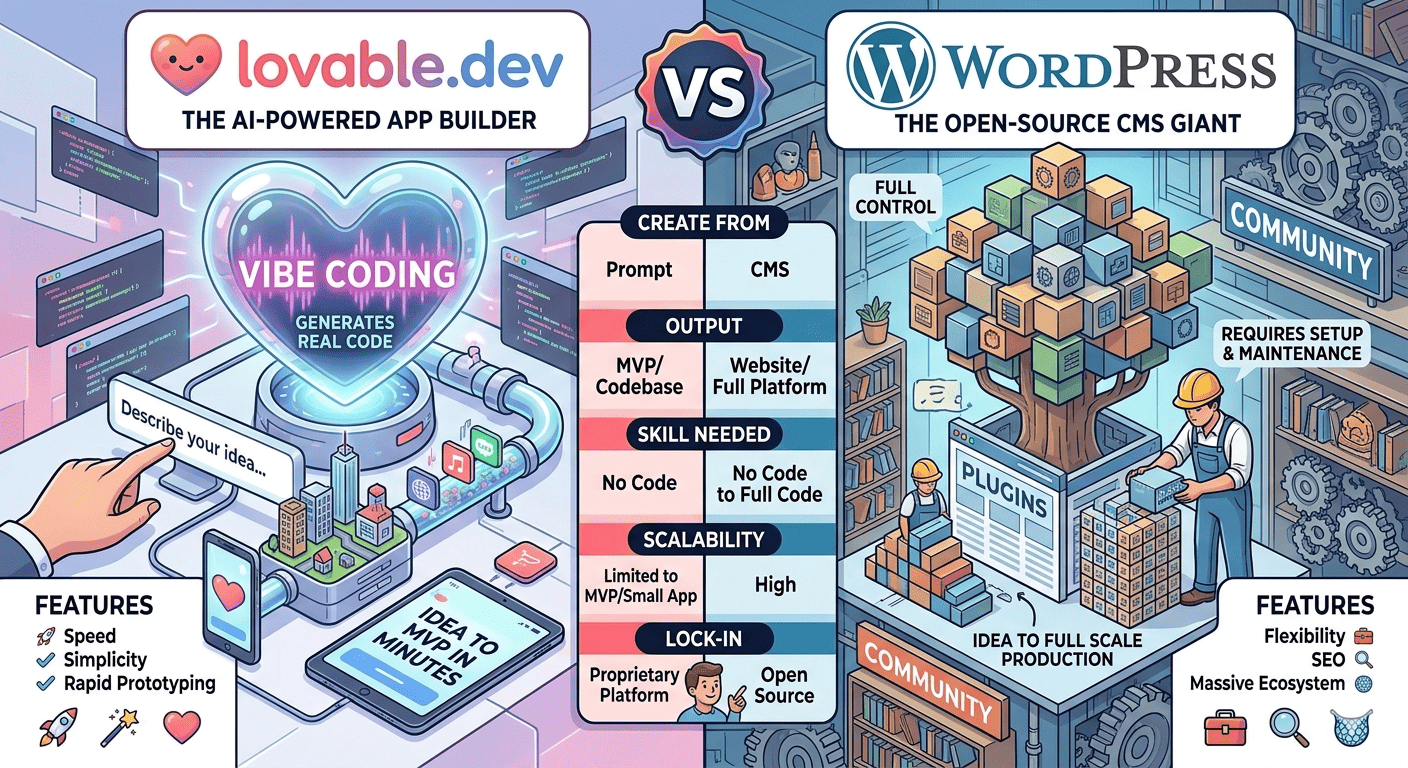
Lovable vs WordPress SEO

Lovable is one of the most popular AI website builders right now, and for good reason. It produces clean, attractive React applications quickly. But from an SEO standpoint, Lovable sites face some serious challenges right out of the gate.

Lovable generates client side rendered React SPAs. That means every site built on the platform sends Google a near empty HTML page by default. Lovable’s own documentation acknowledges this, noting that their platform builds modern web applications using React and Vite, where the browser handles routing and rendering with JavaScript rather than serving a fully assembled HTML page for each URL.

To Lovable’s credit, they have improved the defaults over the past year. When you prompt the tool with SEO specific instructions, it will now generate a robots.txt file, basic meta tags, and OpenGraph tags for social sharing. But these are surface level fixes. The fundamental rendering problem remains.

There are workarounds. You can implement prerendering, which creates static HTML versions of your pages that get served to search crawlers. You can also migrate your Lovable project to a framework that supports server side rendering, like Next.js. But both of these options require technical knowledge, and the migration path means you can no longer use Lovable’s editor to make changes.

For a business owner who chose Lovable because they wanted to avoid coding, this creates an uncomfortable choice: keep using the easy tool and stay invisible to Google, or hire a developer to fix the SEO problems the AI builder created.

Does Google Penalize AI Built Websites?

Does Google Penalize AI Built Websites

No. Google does not penalize a website simply because it was built with AI. Google cares about the quality of the content, the technical health of the site, and the user experience. It does not matter whether a human wrote every line of code or an AI generated it.

That said, Google’s algorithm updates in 2024 and 2025 have heavily targeted thin, generic content, which is exactly the type of content many AI builders produce by default. If your AI built website has cookie cutter copy that reads like it could belong to any business in your industry, you are going to have a hard time ranking regardless of your technical setup.

The combination of client side rendering issues AND generic content is what makes so many AI built sites completely invisible in search results. You are fighting on two fronts at once, and losing both.

How to Make Your AI Built Website SEO Friendly

If you have already built a site with an AI tool and you want it to actually show up in search results, here is what you need to focus on.

Solve the rendering problem first. Nothing else matters if Google cannot read your content. Check your site by right clicking any page, selecting “View Page Source,” and looking for your actual text content. If all you see is JavaScript and an empty div tag, you have a rendering problem. Look into prerendering services or consider migrating to a framework that supports server side rendering.

Set up Google Search Console immediately. This is free and gives you direct visibility into how Google sees your site. Submit your sitemap, check for indexing errors, and monitor which pages are actually appearing in search results. Many business owners with AI built sites have never taken this step, which means they have no idea their pages are not being indexed.

Write unique, specific meta tags for every page. Your title tag and meta description are what show up in search results. Every page on your site should have a unique title that includes the keyword you want to rank for, and a meta description that gives people a reason to click.

Build a real content strategy. AI generated copy is not going to cut it. Google wants to see content written with genuine expertise, especially for topics related to your business. If you are a service based business, write about the specific problems your customers face and how you solve them. A solid content plan is a core part of any effective local SEO strategy for service based businesses.

Add structured data. Schema markup tells search engines exactly what your business is, what services you offer, and other details that can help you appear in rich results. Most AI builders ignore this entirely.

Fix your internal links. Connect your pages to each other in a way that makes sense for both users and search engines. Link from your blog posts to your service pages. Link from your service pages to relevant case studies. Every page on your site should be reachable within two or three clicks from your homepage.

Can an AI Website Builder Replace an SEO Strategy?

Can an AI Website Builder Replace an SEO Strategy

No. And this is the mistake we see most often.

People assume that because the AI builder handled the “website” part, they are done. But building a website and building a website that generates leads are fundamentally different projects. The first one takes hours. The second one takes months of strategic work.

An AI website builder is a construction tool. SEO is the strategy that makes sure people can actually find the building. You would not build a storefront on a road with no traffic and expect customers to just show up. But that is exactly what happens when you launch an AI built website without an SEO plan.

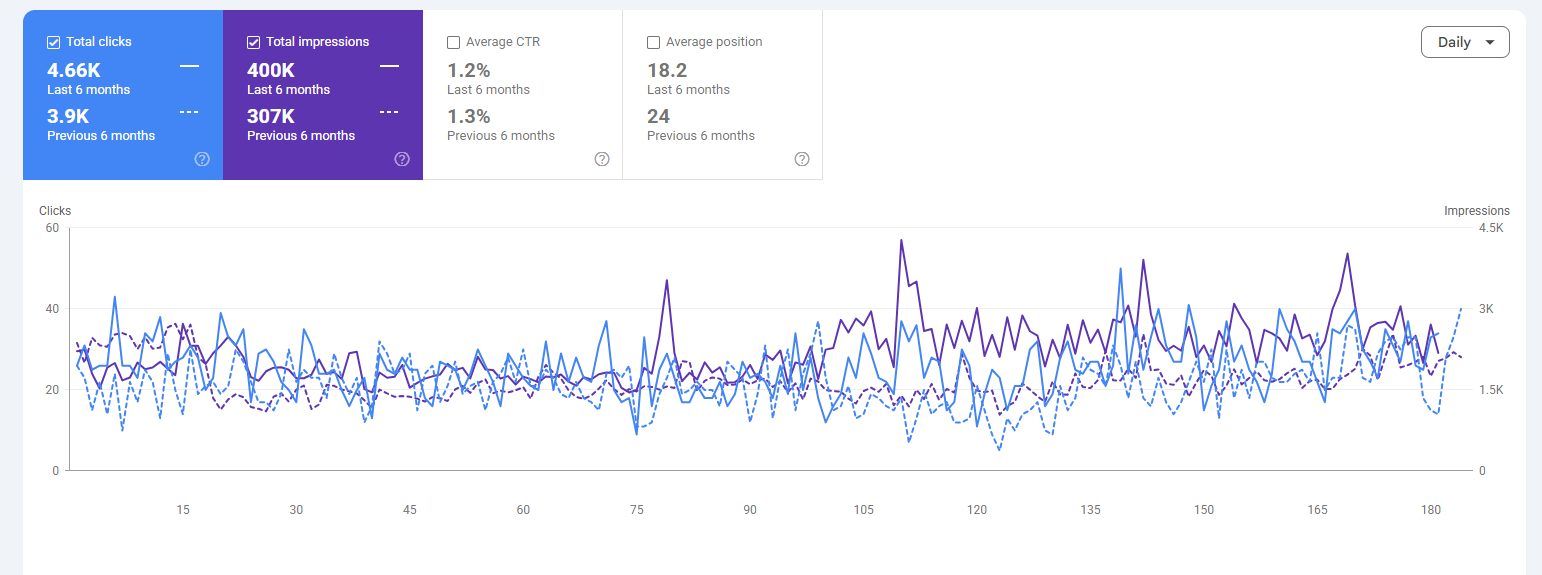
We have seen this play out in real numbers. In one case, a clinic came to us with a site that had been live for over six months with almost zero organic traffic. After a full SEO overhaul that included technical fixes, content development, and a targeted keyword strategy, their organic traffic grew significantly within just a few months. You can see the full breakdown in our clinic SEO case study.

What Should You Do If Your AI Website Is Not Ranking?

Start with an honest assessment of where you stand. Run your URL through Google Search Console and check how many of your pages are actually indexed. View your page source to confirm whether Google can see your content. Test your site speed on Google PageSpeed Insights. Check whether you have unique title tags, proper heading structure, and structured data on your key pages.

If any of these checks come back negative, you have found your starting point. The technical fixes come first, because no amount of good content will help if Google cannot crawl and index your pages.

After the technical foundation is solid, the real work begins. Keyword research, content planning, on page optimization, link building, and ongoing monitoring are what separate a site that exists from a site that ranks.

If this sounds like more than you want to tackle on your own, that is completely understandable. Most business owners did not get into their industry to become SEO experts. That is what we are here for. You can book a free consultation with our team, and we will walk through your site together to identify exactly what needs to happen to get you ranking.

The Bottom Line on AI Website Builders and SEO

AI website builders are genuinely impressive tools for getting a site up and running quickly. They have lowered the barrier to entry for web development in a way that benefits a lot of people. But speed and ease of use do not equal search visibility.

If you are serious about using your website to attract customers and grow your business, you need to treat SEO as a separate, ongoing project. An AI builder gives you the walls and the roof. SEO gives you the address, the signage, and the foot traffic.

Build fast. But build smart. And if your AI built site is sitting on page 10 of Google right now, do not wait another six months hoping things will change on their own. They will not.

Read More
BoostOne May 7, 2026 0 Comments

How We Helped an Aesthetic Clinic Double Its Organic Traffic and Dominate Local Search

A well-established aesthetic clinic offering advanced skin treatments, including laser resurfacing, non-surgical blepharoplasty, IPL, and acne solutions, was struggling to convert its clinical expertise into online visibility.

Read More
BoostOne April 9, 2026 0 Comments