Search visibility has changed dramatically over the last few years. Traditional Search Engine Optimization, or SEO, is still a critical part of online growth, but it is no longer the only way people discover businesses. AI-powered search experiences are now influencing how users find information, compare options, and make decisions. This shift has introduced a new layer of optimization known as Generative Engine Optimization, or GEO.
For business owners and marketing managers, understanding SEO vs GEO is not about picking one strategy over the other. It is about understanding how each works, what role each plays, and why combining them is quickly becoming essential for sustainable visibility.
This article explains SEO and GEO in detail, compares their differences, and shows how they work together to strengthen long-term digital presence.
What SEO Is and Why It Still Matters
Search Engine Optimization is the process of improving a website so it appears more prominently in search engine results when users search for relevant topics, services, or products. SEO focuses on attracting organic traffic from people who already have intent and are actively looking for answers or solutions.
SEO remains one of the most valuable marketing channels because it targets users at the exact moment they are searching.
On-Page SEO
On-page SEO refers to everything that happens directly on your website. This includes keyword usage, page titles, meta descriptions, heading structure, internal linking, image optimization, and the overall quality of your content.
Well-executed on-page SEO helps search engines understand what each page is about while also improving readability and user experience. Pages that are clear, relevant, and easy to navigate tend to perform better both in rankings and engagement.
Off-Page SEO
Off-page SEO focuses on building authority and trust outside your website. The most important element is backlinks, which are links from other reputable websites pointing to your content.
Search engines treat backlinks as signals of credibility. The more high-quality, relevant websites that reference your content, the stronger your authority becomes. Reviews, brand mentions, and citations also contribute to off-page SEO, especially for businesses serving local markets.
Technical SEO
Technical SEO ensures that search engines can properly crawl, index, and understand your website. This includes site speed, mobile usability, secure connections, site structure, and clean indexing signals.
Without strong technical SEO, even the best content can struggle to rank. A technically sound website provides the foundation that allows all other SEO efforts to perform effectively.
Local SEO
Local SEO focuses on visibility for searches with geographic intent. It is especially important for businesses that serve specific cities or regions.
Optimizing a Google Business Profile, managing reviews, maintaining consistent business information, and targeting location-based keywords are all core elements of local SEO. When done correctly, local SEO helps businesses appear in map results and location-driven searches.
Businesses looking to strengthen their foundation can explore professional SEO services that address on-page, off-page, technical, and local optimization together in a cohesive strategy.
What GEO Is and Why It Is Becoming Essential
Generative Engine Optimization is the practice of optimizing content so it can be understood, trusted, and referenced by AI-powered search systems. These systems do not simply rank pages. They generate answers by pulling information from sources they consider authoritative and reliable.
GEO focuses on ensuring your content is structured and written in a way that AI systems can confidently summarize and include when responding to user queries.
How GEO Works
Unlike traditional SEO, GEO does not rely heavily on keyword matching alone. Instead, it emphasizes meaning, context, and clarity.
Key components of GEO include clear explanations, structured formatting, strong topical coverage, and consistent subject authority. Content written for GEO avoids fluff and focuses on answering real questions accurately and directly.
GEO also benefits from well-organized content that uses headings, lists, and natural language. This makes it easier for AI systems to interpret and reuse information correctly.
Businesses that want to stay visible as AI-driven search grows are increasingly investing in Generative Engine Optimization strategies that extend their reach beyond traditional search results.
SEO vs GEO: Understanding the Differences
While SEO and GEO share the same goal of visibility, they operate in different ways.
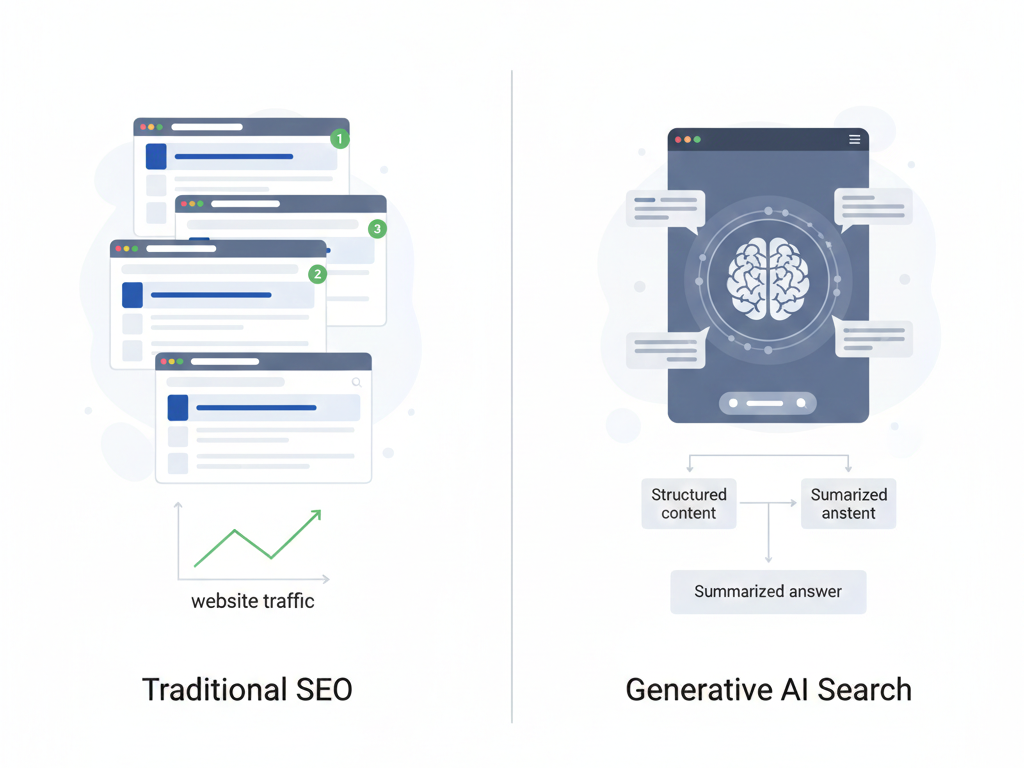
SEO focuses on ranking web pages within search engines like Google and Bing. GEO focuses on whether your brand and content are included in AI-generated answers and summaries.
SEO success is measured through rankings, traffic, and clicks. GEO success is measured through mentions, citations, and inclusion in generated responses.
SEO typically leads users to websites. GEO often provides answers without requiring a click at all. This difference makes GEO especially important as zero-click searches become more common.
Rather than competing, SEO and GEO address different layers of how users now discover information.
Why SEO and GEO Work Better Together
SEO provides the credibility and structure that GEO depends on. AI systems are far more likely to reference content that comes from authoritative, well-optimized websites.
At the same time, GEO ensures that the authority built through SEO extends into AI-powered platforms where many users now begin their research.
When SEO and GEO are aligned, businesses benefit from visibility across both traditional and emerging search experiences. Content becomes discoverable through search engines and reusable by AI systems.
SEO establishes trust. GEO amplifies that trust across new discovery channels.
Real-World Examples Across Industries
Retail and ecommerce businesses use SEO to rank product pages and category listings. GEO helps those same products appear in AI-generated buying guides and comparison summaries.
Service businesses rely on SEO to attract leads searching for specific services. GEO positions those businesses as trusted experts when users ask AI tools for recommendations.
Real estate companies use SEO to capture location-based property searches. GEO supports visibility in AI-driven relocation advice and market explanations.
Restaurants and hospitality brands use SEO to appear in local searches. GEO influences AI-powered travel planning and dining suggestions.
Healthcare organizations depend on SEO for appointment-driven searches. GEO helps ensure accurate and authoritative information is surfaced by AI systems.
Travel and tourism brands rely on SEO for destination content. GEO increases inclusion in AI-generated itineraries and trip planning responses.
Why Businesses Should Invest in GEO Now
Most businesses are still focused entirely on traditional SEO. That creates an opportunity for early adopters.
Investing in GEO now allows brands to establish authority before competition increases. It also ensures that existing SEO content continues to deliver value as search behavior shifts.
GEO does not replace SEO. It strengthens it and extends its lifespan.
How Boost One SEO Approaches SEO and GEO Together
Boost One SEO focuses on building visibility that lasts. This means combining proven SEO fundamentals with forward-looking GEO strategies.
The approach includes strong site structure, authoritative content, clear topical focus, and formatting that supports both users and AI systems. The goal is not short-term rankings but long-term discoverability across how people search today and how they will search tomorrow.
Final Thoughts
SEO vs GEO is not a debate about which strategy is better. It is a recognition that search has evolved.
SEO remains essential for rankings, traffic, and credibility. GEO ensures that credibility carries into AI-powered discovery.
Businesses that understand and implement both are better positioned for the future of search.
Ready to Strengthen Your Search Visibility
If your business wants to improve rankings, remain visible as AI-driven search grows, and build lasting authority, combining SEO and GEO is the right move.
Learn more about SEO services designed to drive sustainable growth, and explore how Generative Engine Optimization can expand your reach into the next generation of search. A smarter strategy today creates stronger results tomorrow.
If you run a flooring, bathroom renovation, or home services company, you’ve probably noticed something frustrating: when potential customers search for services in your area, big directories like Houzz and Angi dominate the first page of Google. These platforms have massive budgets, established domain authority, and seemingly endless resources to throw at SEO.
But here’s what most local contractors don’t realize: You can actually beat them at their own game. The secret isn’t trying to out-spend these giants or copying their tactics. It’s about building something they can’t replicate: a localized, specialized services hub that speaks directly to your community’s needs.
Why Traditional Directory Sites Are Vulnerable
Houzz and Angi might look unbeatable, but they have a fundamental weakness. They’re trying to be everything to everyone, everywhere. Their pages are generic templates that barely mention your specific city or neighbourhood. They’re stuffed with contractor listings from across the country, making it nearly impossible for them to provide genuinely local, relevant content.
Think about it, when someone in your town searches for “bathroom remodelling near me,” they don’t want a national directory. They want someone who understands local building codes, knows which materials hold up in your climate, and has worked on homes similar to theirs. That’s your advantage.
Google’s algorithm has gotten smarter about recognizing truly local businesses versus national aggregators pretending to be local. The search engine wants to show users the most relevant results, and a well-optimized local business website beats a cookie-cutter directory page almost every time.
Building Your Services Hub Foundation
A services hub isn’t just your standard five-page website with a home page, about us, services, gallery, and contact form. It’s a comprehensive resource that establishes you as the definitive expert for home renovation services in your specific market.
Start by mapping out every service you offer, but break them down granularly. If you do bathroom renovations, don’t just have one “Bathroom Remodelling” page. Create separate, detailed pages for shower installations, vanity replacements, tile work, accessibility modifications, and luxury spa bathrooms. Each page should be a deep dive into that specific service, answering every question a homeowner might have.
The structure matters more than you think. Your main service pages should be easily accessible from your homepage, and each should link to related services naturally. If someone is reading about hardwood floor installation, they might also be interested in floor refinishing or waterproof flooring options for kitchens and bathrooms.
Here’s where you really start pulling ahead of the national directories. Every service page should have location-specific information woven throughout the content. Don’t just mention your city once and call it a day; talk about the neighbourhoods you serve, local architecture styles, regional weather considerations, and area-specific challenges.
For example, if you’re a flooring company in a coastal area, discuss how salt air and humidity affect different flooring materials. If you work in an older city with historic homes, explain your experience working within preservation guidelines. Moving companies can talk about navigating narrow city streets or handling moves in high-rise buildings common to the area.
Create dedicated location pages for each city or major neighbourhood you serve. These shouldn’t be thin, duplicate content; each page needs unique, valuable information about serving that specific area. Include details like typical project timelines for local permits, popular design trends in that neighbourhood, and examples of past projects there.
The Content Strategy That Actually Works
Most contractors treat their blog as an afterthought, posting sporadically when they remember or when someone tells them they “should be blogging for SEO.” That approach won’t cut it against established directories.
Your content needs to answer real questions your potential customers are asking. Use tools like Google’s “People Also Ask” sections, look at what people are searching for in your Google Business Profile insights, and pay attention to questions you get during estimates.
Write comprehensive guides that genuinely help people. A post titled “How Much Does Bathroom Renovation Cost in [Your City]?” with actual local pricing ranges, factors that affect cost, and tips for budgeting will attract people in the research phase. A detailed guide on “Choosing the Right Flooring for [Your Region’s] Climate” positions you as an expert while capturing search traffic.
The key is consistency and quality over quantity. Two thoroughly researched, well-written posts per month beat eight thin, generic posts every time. Each piece should be substantial, think 1,500 to 2,500 words, and include images from your actual projects, not stock photos.
Technical SEO Fundamentals You Can’t Ignore
Even the best content won’t rank if your technical foundation is shaky. Unfortunately, many home service companies are making critical mistakes that tank their search visibility. Avoiding common local SEO mistakes can make the difference between page one and page three.
Your website needs to load fast, really fast. If your project gallery images aren’t optimized, they’re likely killing your load time. Compress images before uploading them, and consider lazy loading for galleries. Mobile speed is particularly crucial since most homeowners are searching for services on their phones.
Schema markup might sound technical, but it’s basically code that tells Google exactly what your business does and where you serve. Local business schema, service schema, and review schema all help search engines understand and display your information more prominently. Many platforms have plugins that make this easier than it sounds.
Your site architecture should make sense to both users and search engines. Clear navigation, logical URL structures, and proper internal linking all contribute to better rankings. When you mention related services in your content, link to those service pages using descriptive anchor text, not generic “click here” links.
Houzz and Angi have thousands of reviews, but quantity isn’t everything. What matters are recent, authentic reviews from real local customers. Google puts significant weight on fresh reviews that mention specific services and locations.
Make it ridiculously easy for satisfied customers to leave reviews. Send follow-up emails with direct links to your Google Business Profile, provide business cards with a QR code that goes straight to your review page, and personally ask happy clients when you complete projects.
Display reviews prominently on your website, especially on relevant service pages. If you have a great review about a bathroom renovation, feature it on your bathroom services page. Include photos from the project if the customer allows it.
Build out detailed case studies and project showcases. These serve double duty; they provide fresh content for SEO while demonstrating your expertise and quality. Include before-and-after photos, discuss the challenges, explain your solution, and mention the specific location and services involved.
The Power of Hyper-Local Link Building
Backlinks still matter for SEO, but for local businesses, the quality and relevance of those links matter more than the quantity. One link from your local chamber of commerce website is worth more than ten links from random, irrelevant sites.
Get involved in your community beyond just doing business. Sponsor local sports teams, participate in community events, partner with local real estate agents, or host home improvement workshops at the library. These activities often come with website mentions and links.
Create relationships with complementary local businesses if you do flooring, partner with local interior designers, real estate agents, and home stagers. Many will be happy to link to your resources from their websites, and you can return the favour.
Local news outlets and blogs are always looking for expert sources. When there’s a story about the local housing market, renovation trends, or home improvement tips, reach out as a local expert willing to provide quotes or insights. The resulting articles often include links to your website.
Understanding What Success Actually Looks Like
Don’t obsess over ranking number one for ultra-competitive keywords like “bathroom remodelling” nationally. That’s not the goal, and it’s not where your customers are. Focus on dominating local search terms like “bathroom renovation [your city]” or “flooring company near [neighbourhood].”
Track the right metrics. Traffic is nice, but what matters is qualified leads and conversions. Use Google Analytics to monitor which pages attract visitors who actually contact you or request quotes. Double down on content types that drive conversions, not just traffic.
Monitor your Google Business Profile insights closely. You’ll see which searches trigger your profile, where people are finding you, and how they’re interacting with your listing. This data is gold for refining your SEO strategy.
Watch your competitors, but don’t obsess over them. Check in quarterly on where they rank, what content they’re creating, and which keywords they’re targeting. Use this information to find gaps you can fill, not to copy their strategy.
Building a services hub that outranks major directories takes time and consistent effort. Most contractors either try to do everything at once and burn out, or they procrastinate indefinitely because it feels overwhelming.
Start with your most profitable services. If bathroom renovations are your bread and butter, build out those pages first: the main service page, specialized sub-pages, related blog content, and location variations. Get that dialled in before moving to your next service line.
Create a realistic content calendar. Maybe you write one detailed service page and one blog post each month. That’s 24 pieces of substantial content per year, which is more than most of your competitors will produce.
Consider where your skills are best used. If you’re great at sales and project management but writing makes you miserable, it might be worth working with professionals who understand both home services and SEO. The services that can support your growth often pay for themselves quickly through better rankings and more leads.
Getting Started Today
The best time to start building your services hub was a year ago. The second-best time is now. While you’re waiting and thinking about it, your competitors might be implementing these strategies and claiming the top spots in search results.
Begin with an honest assessment of where you stand. How does your current website stack up against the directories you’re trying to outrank? What content gaps exist? Which services or locations aren’t adequately covered? A thorough free SEO analysis can identify specific opportunities and quick wins for your business.
Pick one action item from this article and implement it this week. Maybe that’s creating a new location page, writing a detailed service page, or asking your last three happy customers for reviews. Small, consistent actions compound into significant results.
Remember, Houzz and Angi aren’t going anywhere, but they’re not unbeatable. They’re slow-moving corporations with generic content strategies. You’re a nimble local business with genuine expertise and community connections. Use those advantages, build your authoritative services hub, and watch as you climb past the directories to capture the customers who are actively looking for what you offer in your area. The opportunity is there. The question is whether you’ll take action while your competitors are still complaining about how hard it is to compete with big directories.
Your competitor down the street is getting customers you should be getting. While you’re scratching your head, wondering why foot traffic has slowed down, they’re booking appointments and ringing up sales from customers who found them through a simple Google search.
The harsh reality? Most local businesses are hemorrhaging potential customers because of easily fixable local SEO mistakes. When someone searches for “coffee shop near me” or “plumber in Chicago,” Google decides which businesses show up first. If your business isn’t appearing in those crucial top spots, you’re practically invisible to potential customers actively looking for what you offer.
Local search drives real business results. Studies show that 76% of people who conduct a local search visit a business within 24 hours, and 28% of those searches result in a purchase. That’s not just website traffic we’re talking about, that’s actual paying customers walking through your door or picking up the phone to hire you.
The good news is that most of your competitors are making the same fundamental local SEO mistakes. Fix these five critical errors, and you’ll start capturing customers that are currently going to other businesses. Let’s dive into what’s costing you money and how to turn things around.
Mistake #1: Incomplete or Inconsistent Google Business Profile
Your Google Business Profile is your digital storefront, and most businesses are leaving money on the table by treating it like an afterthought. If you’ve claimed your listing but haven’t fully optimized it, you’re essentially putting up a “Closed” sign when customers are ready to buy.
The Problem
Walk through your neighbourhood and count how many businesses have incomplete Google Business Profiles. You’ll find missing phone numbers, outdated hours, no website links, and business descriptions that say nothing useful. Some businesses haven’t even uploaded a single photo, while others show pictures from five years ago when they had completely different branding.
Even worse is inconsistent information. Maybe your Google listing says you’re open until 9 PM, but your website says 8 PM. Your Facebook page lists a different phone number than Google. Your address is formatted differently across platforms. This confusion doesn’t just frustrate customers, it tells Google that your business information isn’t trustworthy.
Why It Matters for Your Bottom Line
Google’s algorithm prioritizes businesses that provide complete, accurate, and consistent information. When your profile is incomplete or inconsistent, Google shows your business less frequently in local search results. You drop from the coveted “map pack” (those top three local results) down to the regular search results, where fewer people click.
Think about it from a customer’s perspective. If they can’t find your current hours or phone number easily, they’ll click on your competitor’s listing instead. Every incomplete field is a potential lost customer.
The Fix: Your Google Business Profile Optimization Checklist
Start by claiming and verifying your Google Business Profile if you haven’t already. Then work through this optimization checklist:
Complete every single field: Business name, address, phone number, website, hours, categories, and business description. Google rewards completeness.
Upload high-quality photos regularly: Include exterior shots, interior photos, your team at work, and your products or services in action. Businesses with photos receive 42% more requests for directions and 35% more clicks to their websites.
Write a compelling business description: Use your main keywords naturally while explaining what makes your business unique. Focus on what customers care about, not industry jargon.
Keep your hours updated: This includes holiday hours, seasonal changes, and any temporary modifications. Outdated hours are one of the fastest ways to lose potential customers.
Add your service areas: If you serve customers beyond your physical location, specify those areas. This helps you show up in searches from surrounding communities.
Enable messaging: Let customers contact you directly through your Google listing. Quick responses can turn searchers into customers faster than any other method.
Pro Tip for Multiple Locations
If you operate multiple locations, create separate Google Business Profiles for each one. Never use a single profile for multiple locations, Google will penalize you for it. Each location should have its own unique content, photos, and local phone number when possible. This approach helps you dominate local search results across all your service areas.
For businesses with multiple service pages, each location can link to location-specific service pages to maximize your local search visibility.
Mistake #2: Ignoring Online Reviews
Reviews aren’t just nice to have, they’re a ranking factor that directly impacts your visibility in local search results. Yet most businesses either ignore reviews entirely or handle them so poorly that they’re actually hurting their reputation.
The Problem
Some businesses have five reviews from 2019 and wonder why they’re not showing up in local searches. Others have dozens of reviews but never respond to any of them, missing opportunities to engage with customers and show potential clients that they care about service quality.
The worst mistake? Getting defensive or argumentative with negative reviews. Nothing kills your online reputation faster than a business owner having a public meltdown in the review section.
The Impact on Your Business
Here’s a number that should grab your attention: 87% of consumers read online reviews before visiting a local business. Your review profile isn’t just about reputation, it’s about whether people choose you over competitors.
Google also uses review signals as a ranking factor. Businesses with more recent, positive reviews tend to rank higher in local search results. The review velocity (how often you get new reviews) matters more than just having a high star rating.
The Fix: Building Your Review Generation Strategy
Make asking for reviews part of your standard process: After completing a service, sending a product, or finishing a transaction, ask satisfied customers to leave a review. The keyword is “satisfied”, don’t ask everyone, ask people who had a positive experience.
Timing matters: Ask for reviews when the positive experience is fresh in their minds. For service businesses, this might be immediately after completion. For retail, it could be a week after purchase when they’ve had time to use the product.
Make it easy: Send direct links to your Google Business Profile review section. The fewer clicks required, the more reviews you’ll receive.
Response strategy: Respond to every review, both positive and negative. Thank positive reviewers and address negative concerns professionally. Your responses show potential customers how you handle problems.
Handling Negative Reviews Professionally
When you get a negative review, resist the urge to defend yourself immediately. Instead, acknowledge the customer’s experience, apologize for any inconvenience, and offer to resolve the issue offline. This approach shows potential customers that you take feedback seriously and work to fix problems.
Example response: “Thank you for your feedback, Sarah. I’m sorry your experience didn’t meet your expectations. I’d love to discuss this further and see how we can make things right. Please call me directly at [phone number] so we can resolve this quickly.”
Mistake #3: Missing Local Keywords in Website Content
Your website might look great, but if it’s not speaking Google’s local search language, you’re invisible to customers in your area. Most businesses optimize for broad terms while completely ignoring the local keywords that actually drive foot traffic and phone calls.
The Problem: Generic vs. Local Keyword Targeting
Too many businesses target generic keywords like “marketing agency” or “Italian restaurant” instead of local variations that customers actually search for. Meanwhile, your potential customers are typing “marketing agency in Phoenix” or “Italian restaurant downtown Denver” into Google.
Here’s the difference in action: A pizza restaurant optimizing for “pizza restaurant” competes against every pizza place in the world. The same restaurant optimizing for “pizza restaurant in downtown Austin” competes against maybe 20 local businesses, much better odds.
Understanding Local Search Intent
When people search for local businesses, they use specific patterns:
“[Service] near me”
“[Service] in [City]”
“[Service] [Neighbourhood]”
“[Service] [City, State]”
Your website content needs to match these search patterns naturally. This doesn’t mean stuffing keywords awkwardly into every sentence, it means writing content that addresses local search intent while providing real value.
The Fix: Local Keyword Research and Implementation
Start with keyword research tools: Use Google Keyword Planner, Ahrefs, or SEMrush to identify local variations of your main keywords. Look for terms with decent search volume but lower competition.
Analyze your competitors: See which local keywords your top-ranking competitors target. Tools like SEMrush can show you exactly which terms drive traffic to their websites.
Create location-specific content: Instead of generic service pages, create pages that target your specific service areas. A roofing company might have separate pages for “roof repair in Arlington” and “roof repair in Fort Worth.”
Optimize your homepage: Include your city or region in your main heading and throughout your homepage content. Your homepage should clearly communicate where you’re located and whom you serve.
Use local keywords in your blog content: Write about local events, news, or issues related to your industry. A landscaping company might write about “Best Plants for Colorado Springs Winters” or “Xeriscaping Tips for Denver Homeowners.”
Warning: Avoid Keyword Stuffing
While local keywords are important, cramming them unnaturally into your content hurts more than it helps. Google’s algorithm is sophisticated enough to recognize keyword stuffing and will penalize your site for it.
Instead of: “Our Denver plumbing company provides Denver plumbing services to Denver residents in Denver, Colorado.”
Try: “Our experienced plumbing team serves homeowners throughout Denver and surrounding communities with reliable, affordable plumbing services.”
The second example sounds natural while still including your target location and keywords.
Mistake #4: No Local Citations or Inconsistent NAP Data
Citations are mentions of your business information across the web, and they’re a crucial local SEO ranking factor that most businesses completely ignore. Even worse, many businesses have inconsistent NAP (Name, Address, Phone) data across different platforms, which confuses Google and hurts their local rankings.
The Problem: Information Chaos Across the Web
Your business information appears in more places online than you realize. Beyond your website and Google Business Profile, your NAP data might be listed on Yelp, Yellow Pages, Facebook, industry directories, local chamber of commerce websites, and dozens of other platforms.
When this information is inconsistent, maybe your address is abbreviated on one site but spelled out on another, or your phone number includes dashes on some platforms but not others, Google doesn’t know which version to trust. This uncertainty directly impacts your local search rankings.
Why Google Cares About Citation Consistency
Google’s local search algorithm uses citations as a trust signal. When your business information appears consistently across multiple authoritative websites, it confirms to Google that your business is legitimate and established in the community.
Inconsistent citations have the opposite effect, they make Google less confident about your business information, which translates to lower rankings in local search results.
The Fix: Citation Audit and Management Strategy
Start with a citation audit: Search for your business name online and make a list of every platform where your information appears. Note any inconsistencies in formatting, phone numbers, addresses, or business names.
Prioritize major platforms: Focus first on high-authority directories like Google My Business, Yelp, Facebook, Apple Maps, and Bing Places. These carry more weight with search engines.
Industry-specific directories: Find directories specific to your industry. A restaurant should be listed on Zomato and OpenTable, while a contractor should appear on Angie’s List and HomeAdvisor.
Local directories: Don’t forget about local chamber of commerce websites, city business directories, and regional platforms specific to your area.
Maintain consistency: Choose one format for your business information and use it everywhere. If your official address is “123 Main Street,” don’t use “123 Main St.” on other platforms.
Tool Recommendations for Managing Citations
Moz Local: Scans the web for your business listings and identifies inconsistencies across major platforms.
BrightLocal: Provides citation tracking and helps you manage listings across multiple directories.
Yext: Automates the process of updating business information across hundreds of platforms simultaneously.
For businesses needing comprehensive local SEO support, professional SEO services can handle citation management as part of a broader local optimization strategy.
Mistake #5: Weak Local Content Strategy
Content marketing isn’t just for big corporations, local businesses need content strategies too. The problem is that most local businesses either create no content at all or produce generic content that could apply to any business anywhere in the world.
The Problem: Missing Local Content Opportunities
Your competitors are probably writing blog posts about industry trends or general tips, completely missing the local angle that could help them dominate search results in your area. Meanwhile, potential customers are searching for information about local events, regulations, weather impacts, and community-specific concerns related to your industry.
Local content opportunities most businesses miss:
Local event participation and sponsorships
Community involvement and charitable activities
Local industry news and its impact on customers
Area-specific challenges your service solves
Seasonal considerations unique to your region
The Business Impact of Local Content
Local content serves multiple purposes: it helps you rank for local search terms, establishes you as a community expert, and gives you content to share on social media that resonates with your local audience.
A local HVAC company writing about “Preparing Your Air Conditioner for Phoenix Summers” will rank better for Phoenix-related searches than one writing generic articles about air conditioner maintenance.
The Fix: Building Your Local Content Calendar
Seasonal content: Plan content around local weather patterns, seasonal business cycles, and community events. A landscaping company might write about “Fall Leaf Cleanup Tips for Minneapolis Homeowners” or “Snow Removal Services in Minnesota.”
Local event coverage: Attend community events, sponsor local organizations, or participate in charity drives, then write about your involvement. This content naturally includes local keywords and shows community engagement.
Neighbourhood-specific pages: Create detailed pages about the specific neighbourhoods or cities you serve. Include information about local landmarks, demographics, and how your services address area-specific needs.
Local news angles: Monitor local news for stories that relate to your industry. A security company might write about local crime statistics or new safety regulations affecting homeowners in their area.
Examples of Successful Local Content
Restaurant example: “Best Date Night Spots in Downtown Salem” (includes their restaurant among others, positions them as local experts)
Real estate example: “Moving to Austin: A Complete Neighbourhood Guide” (targets people relocating to their area)
Home services example: “How Denver’s Hard Water Affects Your Plumbing” (addresses a specific local issue their services solve)
The key is creating content that’s genuinely useful to your local audience while naturally incorporating the keywords that help you rank in local searches.
Conclusion: Turn These Fixes Into Customers
These five local SEO mistakes are costing you customers right now, but the flip side is exciting: fixing them gives you an immediate competitive advantage. While your competitors continue making these errors, you can capture the customers they’re losing.
The ROI potential is significant. Local businesses that invest in proper local SEO typically see increases in phone calls, website visits, and foot traffic within 90 days. More importantly, these are qualified leads from people actively searching for your services in your area.
Start with your Google Business Profile optimization, it’s free and can show results quickly. Then work through the other areas systematically. You don’t need to fix everything overnight, but you do need to start.
Ready to stop losing customers to competitors who simply show up better in local search results? We offer a free local SEO assessment that identifies exactly which of these mistakes are hurting your business and provides a prioritized action plan to fix them.
Don’t let another month of potential customers slip away. Your business deserves to be found by the people who need your services most.