Montreal, QC • Updated March 2026
Top Industries in Montreal Most Exposed to AI-Driven Search
What this page is: the public reference page behind our press release. It explains how AI-driven search is changing customer discovery in Montreal, shows what AI results look like, and provides a clear plan to protect (and grow) lead flow.
The problem in one line: when AI answers summarize options and cite third-party sites, fewer people click— and brands that aren’t cited can quietly fall off the shortlist.

Top industries in Montreal most exposed to AI-driven search
“Exposure” is the likelihood that AI answers change how prospects discover and choose providers in your category. The list below reflects typical user behavior in Montreal: high-intent, comparison-heavy searches (“best,” “cost,” “reviews,” “near me”), and categories where AI can confidently summarize options and cite sources.
| Rank | Industry | Why it’s highly exposed | Common AI-style queries |
|---|---|---|---|
| 1 | Plastic surgery & cosmetic services | Decision-heavy research, strong “best / cost / safety” intent, and frequent citation of directories and editorial roundups. | “Best [procedure] Montreal”, “Cost of [procedure]”, “Risks & recovery time” |
| 2 | Legal | High trust barrier and “how to choose” behavior. AI summaries often cover process, timelines, and what to ask before hiring. | “Best lawyer for [issue]”, “How much does a lawyer cost?”, “What to expect” |
| 3 | Dental | High-intent searches (including urgent), strong comparison behavior, and lots of quick-answer questions AI can summarize. | “Emergency dentist Montreal”, “Invisalign cost”, “Implant vs bridge” |
| 4 | Home services (HVAC, plumbing, electrical) | Urgency + price/timeline questions. AI answers often provide quick guidance and cite directories before users click. | “Furnace repair cost”, “Plumber near me”, “How fast can [service] be done?” |
| 5 | Finance & insurance | Aggregator-heavy ecosystem (quotes, comparisons). AI frequently summarizes options and cites third-party comparison sources. | “Best car insurance Montreal”, “Life insurance comparison”, “Mortgage rate basics” |
| 6 | Hospitality (hotels, restaurants, attractions) | No-click lists and itinerary-style answers. AI can recommend and rank options directly in the result. | “Best hotels downtown”, “Best brunch”, “Things to do this weekend” |
| 7 | Real estate | Research-first funnel (fees, process, neighborhoods). AI summarizes the buying/selling process and “how to choose an agent.” | “Agent commission Montreal”, “Best neighborhoods”, “How to sell fast” |
| 8 | Accounting | Process and pricing questions are easy to summarize; trust signals matter; directories often appear in citations. | “CPA for small business”, “Tax deadlines”, “Bookkeeping cost” |
| 9 | SaaS & B2B services | Comparison intent is extremely high; AI answers lean on “best tools” lists and review aggregators unless first-party pages are strong. | “Best [software] for…”, “Alternatives to…”, “Pricing comparison” |
| 10 | E-commerce & retail | Product discovery shifts to comparisons, “best for” recommendations, and availability questions; exposure varies by product category. | “Best [product]”, “Where to buy [product] Montreal”, “Is [product] worth it?” |
If you’re in any of the top 6: the biggest risk is not “a ranking drop.” It’s being missing from the shortlist that forms inside the AI answer. The fastest way to get clarity is to map your exact services + Montreal intent searches and check what AI is showing today.
Book a Free Strategy SessionWhat’s changing (and why it impacts leads)
The answer appears before the click
AI summaries handle early research (pricing ranges, timelines, pros/cons). Fewer people click just to “learn the basics.”
Citations shape the shortlist
Visibility now includes being cited or referenced inside the answer—not only your position in the traditional results.
Third parties can take the credit
Directories, review platforms, and editorial lists often get cited. If your brand isn’t strong across trust surfaces, you can be overlooked.
The practical response is a combined plan: strong service pages + strong local trust signals + GEO (being citable in AI answers), and Google Ads only when it’s profitable.
Evidence: what AI results look like for Montreal searches
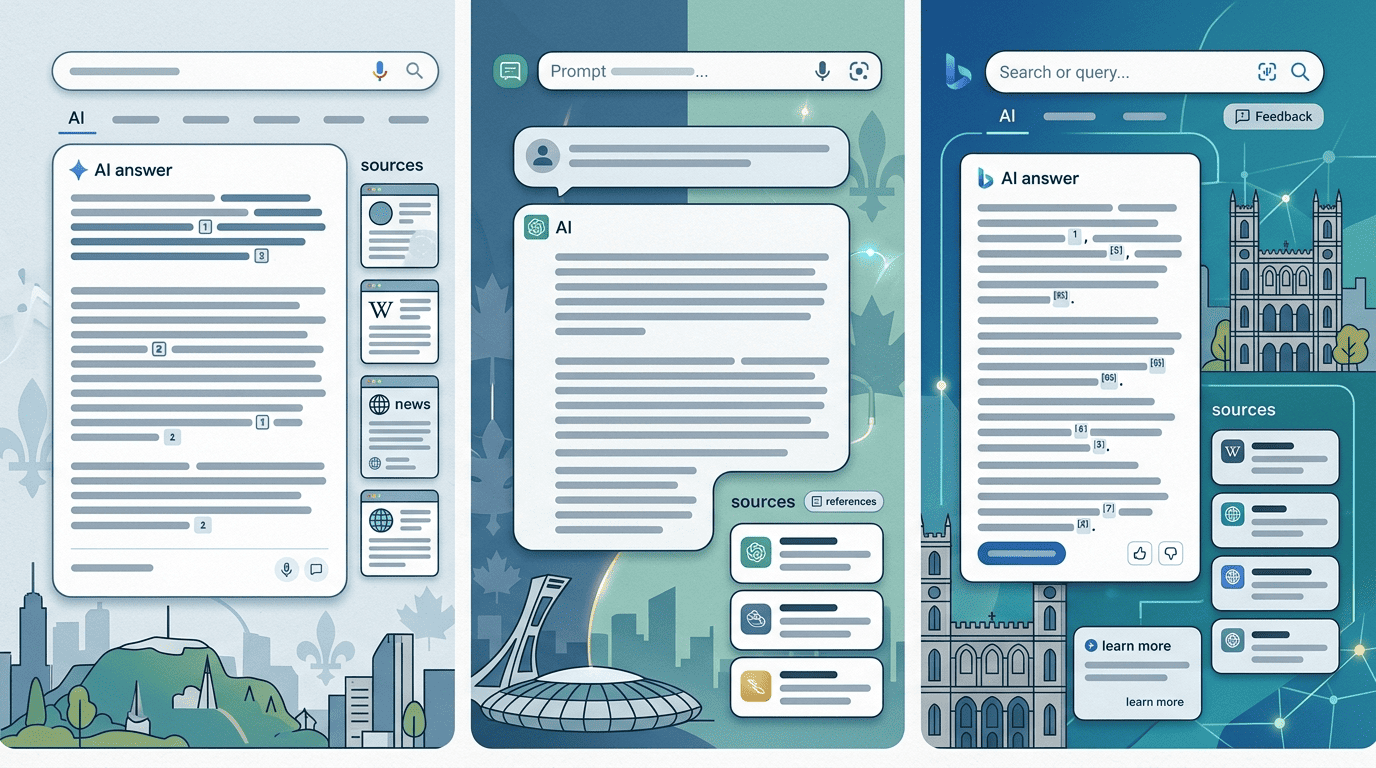
Example: AI Overviews-style result
Typical pattern: summary → citations/sources → traditional results.
What usually gets cited
In many local categories, AI answers cite sources that are consistent, widely referenced, and easy to parse: directories, review platforms, editorial roundups, and clear first-party service pages.
- Directories & listings
- Review platforms
- Editorial “best of” pages
- Strong, scannable service pages
What to watch for on your own searches
- Do you see a shortlist inside the AI answer?
- Are your competitors cited but you are not?
- Are citations dominated by directories?
- Is the answer “good enough” to reduce clicks?
Exposure Score (0–100): how we measure “AI search exposure”
To keep this measurable (not buzzwords), the benchmark uses an exposure model built from four signals: how often AI answers appear, how often they enable no-click decisions, how much they cite aggregators, and how often local brands are excluded.
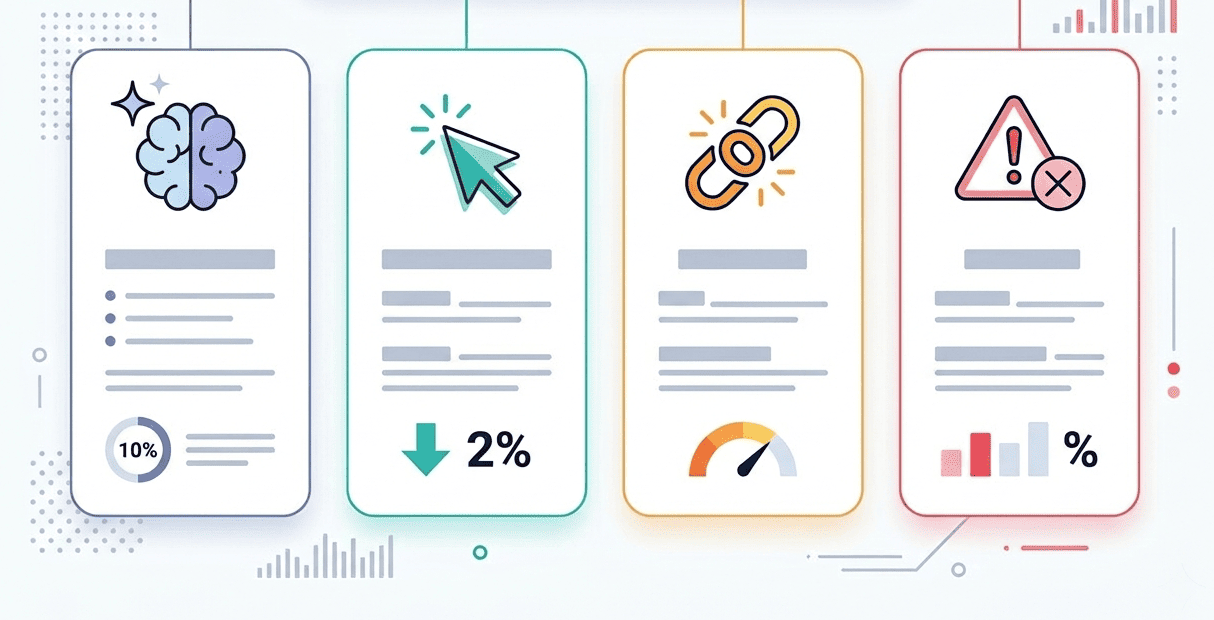
1) AI answer prevalence
How often AI summaries/shortlists appear for high-intent queries in your category.
2) No-click summary risk
How often the answer provides enough to choose without visiting websites.
3) Aggregator citation share
How often directories/review sites dominate citations vs. first-party sources.
4) Brand exclusion
How often local brands are missing from citations/recommendations.
What to do next (solution path)
The goal isn’t to “chase AI.” The goal is to build the kind of presence AI systems naturally surface because it’s clear, consistent, and trustworthy—while improving classic rankings and conversion.
1) Strengthen Montreal SEO fundamentals
Technical performance, service-page clarity, internal linking, and intent-driven content that converts.
Learn more: Montreal SEO
2) Build the local trust layer
Profiles, NAP consistency, reviews, and local citations that help you win local intent.
Learn more: Local SEO Montreal
3) Add GEO (AI answer visibility)
Make your brand easier to cite: clearer answers, stronger entity signals, and decision-ready pages.
Learn more: Generative Engine Optimization
4) Use Google Ads (optional)
Capture high-intent demand while SEO/GEO compounds—especially in competitive categories.
Learn more: Google Ads Management
Free Strategy Session: what you get
AI visibility snapshot (your category + Montreal)
- Where AI summaries appear for your services
- Who gets cited (brands vs directories)
- Where you’re missing from the shortlist
Prioritized action plan
- Pages to build or restructure
- Local signals to strengthen
- Trust surfaces to improve
Channel mix recommendation
- What to fix with SEO vs GEO
- Whether Google Ads makes sense for ROI
- 30/60/90-day execution plan
Book your strategy session
Bring your website URL and your top 3 services. We’ll handle the analysis.
Book a Free Strategy SessionMethodology (transparent + repeatable)
This benchmark is designed to be repeatable and auditable: Montreal-focused query sets, consistent settings, and documented evidence (screenshots + notes) so you can track changes over time.
| Component | Specification |
|---|---|
| Industries covered | Legal, Dental, Plastic surgery/cosmetic, Home services, Accounting, Real estate, SaaS/B2B, E-commerce/retail, Finance/insurance, Hospitality |
| Surfaces reviewed | Google AI Overviews, ChatGPT Search, Bing Copilot Search |
| Signals | AI prevalence, no-click summary risk, aggregator citation share, brand exclusion |
| Output | Industry exposure ranking + guidance on Montreal SEO, local SEO, GEO, and PPC alignment |
FAQ
What is this page?
It’s the public reference page behind our press release. It explains AI-driven search exposure, shows what results can look like, and provides a clear, practical path forward for Montreal businesses that rely on search leads.
Is this replacing normal Montreal SEO?
No. It expands it. Traditional SEO still matters; GEO focuses on the added layer—being cited and shortlisted inside AI answers.
Do you manage Google Ads?
Yes. If PPC is the right lever for your category, we’ll outline a plan: Google Ads Management.
What happens in the strategy session?
We review your services + Montreal intent searches, show what AI answers look like, who gets cited, where you’re missing, and provide a prioritized action plan.